An Emergency Shutdown Valve (ESDV) is an important safety device used in industrial plants to prevent hazardous situations from escalating. It automatically isolates the flow of gas, liquid, or other process fluids when an emergency condition is detected. The valve receives a shutdown command from the Emergency Shutdown System (ESD) and moves to its predetermined safe position, usually fully closed.
ESDVs are commonly installed in oil and gas facilities, refineries, chemical plants, pipelines, offshore platforms, and other process industries. Their primary purpose is to reduce the risk of fire, explosion, equipment damage, and uncontrolled release of hazardous materials.
What Is an ESDV?
An Emergency Shutdown Valve (ESDV) is an actuated safety valve designed to stop process flow during an abnormal or emergency operating condition. It is generally operated by a pneumatic, hydraulic, or electric actuator connected to a safety instrumented system (SIS).
During normal plant operation, the ESDV remains in its specified operating position, typically fully open. When the safety system detects a hazardous condition and issues a shutdown command, the actuator moves the valve to its designated safe position.
Depending on the process design, the valve may be configured to fail closed, fail open, or remain in its last position. However, emergency isolation applications commonly use a fail-closed arrangement.
How Does an ESDV Work?
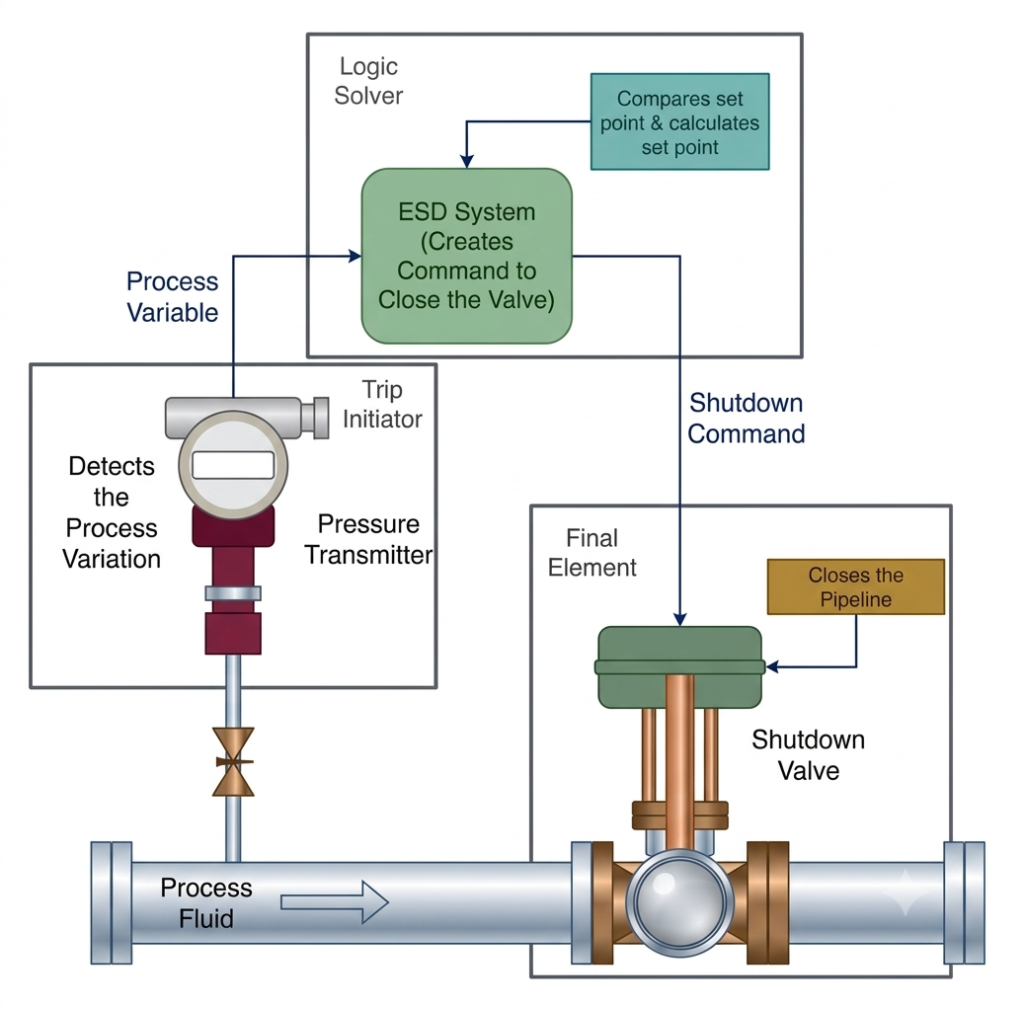
The working principle of an ESDV involves continuous monitoring of process conditions, detection of an abnormal event, and automatic valve operation through the safety instrumented system.
The ESD system receives signals from field instruments such as pressure transmitters, temperature sensors, gas detectors, and fire detectors. When a monitored variable reaches a defined trip condition, the safety logic solver processes the signal and sends a command to the shutdown valve.
The actuator then moves the valve to its predetermined safe position and isolates the process flow.
Normal Operating Condition: Valve Fully Open
Under normal operating conditions, the ESDV remains fully open, allowing process fluid to pass through the pipeline with minimal flow restriction.
In a full-bore ball valve design, the opening through the ball is approximately equal to the internal diameter of the connected pipeline. This arrangement helps reduce pressure loss and flow disturbance.
The actuator holds the valve in its required operating position, while the safety system continuously monitors the relevant process conditions.
Emergency Condition: Valve Moves to Safe Position
When an emergency condition is detected, the ESD system generates a shutdown signal. This signal operates the valve’s solenoid valve or other actuator control arrangement, causing the actuator to move the valve to its predetermined safe position.
For a fail-closed ESDV, the actuator closes the valve and stops the flow of process fluid. The closing time depends on the valve size, actuator capacity, process conditions, and project safety requirements.
The valve is selected to provide the required shutoff performance, helping prevent further release of hazardous material.
How Is an ESDV Reset After an Emergency Shutdown?
An ESDV generally does not return to its normal operating position automatically unless the system has been specifically designed to permit automatic resetting.
Before reopening the valve, the cause of the shutdown must be identified and the process must be confirmed safe. Depending on the ESD system design, resetting may involve the following actions:
- Manual reset: An authorized operator resets the shutdown system after investigating and clearing the cause of the trip.
- Restoration of normal process conditions: The relevant process variable must return to its acceptable operating range.
- Restoration of power or instrument air: Any loss of electrical power, hydraulic pressure, or instrument air must be addressed if it contributed to the shutdown.
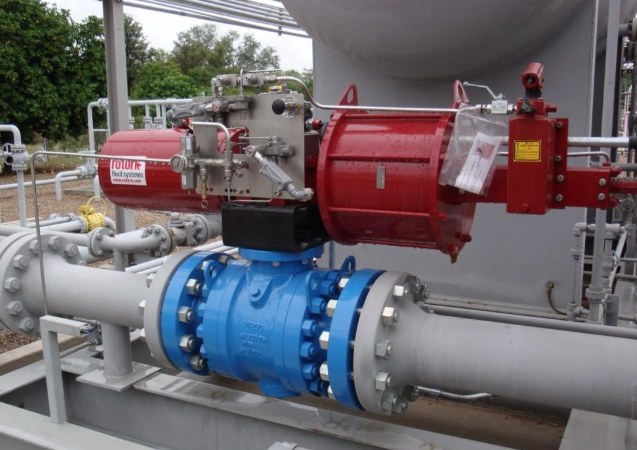
The actuator may also include a local position indicator to show whether the valve is open, closed, or in an intermediate position. This helps operators verify the actual valve position during inspection and maintenance.
Importance of Fast ESDV Operation
An ESDV must operate within the specified shutdown time to limit the consequences of a hazardous event. A delayed response can allow additional process fluid to enter the affected section, increasing the potential severity of an incident.
Quarter-turn ball valves are commonly used for emergency isolation because they can move between fully open and fully closed positions with a 90-degree rotation. Their operating speed depends on actuator sizing and the required closing-time specification.
The valve’s flow characteristics and shutoff capability also influence its performance. However, the primary requirement of an ESDV is reliable isolation during a safety demand, rather than ordinary process flow regulation.
ESDV Testing and Safety Integrity Level (SIL)
An ESDV used as part of a Safety Instrumented Function (SIF) must meet the safety performance requirements established during the safety assessment.
The required Safety Integrity Level (SIL) is determined through risk assessment and safety instrumented system design. The valve, actuator, solenoid valve, and associated components contribute to the overall performance of the shutdown function.
Regular testing is necessary to identify hidden failures that may prevent the valve from operating when required.
Proof Testing
A proof test is a planned test performed to detect dangerous undetected failures in a safety instrumented function.
During the test, the valve and its associated components are checked to verify that they can perform their intended safety function. The testing procedure may include checking the actuator, solenoid valve, valve movement, limit switches, and final closed position.
A complete proof test may require process isolation or a plant shutdown, depending on the installation and test arrangement. The test frequency and coverage should follow the SIL verification calculations and approved maintenance procedures.
Diagnostic Testing and Partial Stroke Testing
Diagnostic testing helps identify certain failures without requiring a complete shutdown of the process.
One commonly used method is Partial Stroke Testing (PST). During PST, the ESDV is moved through a limited portion of its travel while the process remains in operation. This helps identify problems such as actuator malfunction, sticking, or mechanical resistance.
However, partial stroke testing does not verify every possible failure mode. It cannot replace a full proof test unless the safety design and applicable procedures specifically establish an acceptable testing strategy.
Shutdown Valve (SDV) vs Emergency Shutdown Valve (ESDV)
Shutdown Valve (SDV) and Emergency Shutdown Valve (ESDV) are both actuated valves used to isolate process flow. Their mechanical construction and accessories may be similar. The main distinction is the function they perform within the plant’s control and safety system.
| Basis | Shutdown Valve (SDV) | Emergency Shutdown Valve (ESDV) |
| Purpose | Isolates process flow during a specified shutdown operation | Isolates process flow during an emergency |
| Activation | Operated by a shutdown or control command according to the process design | Operated by an emergency signal from the ESD system |
| Application | Used for process isolation and shutdown requirements | Used for emergency isolation and risk reduction |
| Safety Function | Depends on its assigned function in the system | Commonly forms part of a Safety Instrumented Function (SIF) |
| Operation | May operate during normal, planned, or abnormal shutdown conditions | Operates when an emergency trip condition is detected |
An SDV is a general term for an actuated valve used to stop process flow under defined operating conditions. An ESDV specifically performs an emergency isolation function when an emergency shutdown signal is generated.
In many plants, the terms SDV and ESDV may be used differently depending on project specifications, engineering standards, and equipment tagging practices. Some projects use the SDV tag even when the valve performs an emergency shutdown function. Therefore, the shutdown logic diagram and safety instrumented function documentation should be checked to identify its actual role.
Applications of ESDVs
Emergency Shutdown Valves are installed in process systems where rapid isolation of fluid flow is necessary to protect people, equipment, and the environment.
Common applications include:
- Oil and gas production: Isolating hydrocarbon flow from wells, separators, and processing equipment.
- Refineries: Preventing the uncontrolled flow of flammable liquids and gases during emergency conditions.
- Offshore platforms: Isolating pipelines and process equipment to reduce the consequences of leaks or fire.
- Chemical plants: Stopping the flow of hazardous chemicals when abnormal operating conditions occur.
- Gas pipelines: Providing emergency isolation at selected pipeline sections and terminal facilities.
- Storage facilities: Isolating tanks and transfer lines during fire, leakage, or other emergency events.
Conclusion
An Emergency Shutdown Valve (ESDV) is a critical component of industrial process safety. It receives a shutdown command from the ESD system and moves to its predetermined safe position to isolate process flow during an emergency. Proper actuator selection, suitable valve design, reliable safety logic, and periodic proof testing are essential to ensure that the ESDV performs its intended function when demanded.
Read Next:
- Basics of Restriction Orifice (RO) – Types, Applications, and Standards
- Orifice Beta Ratio
- Basics of Orifice Plates
- Orifice Plate Tapping
- What is a Spool Valve? – Types, Configurations, and Applications
- Working Principle of Control Valve with Diagram, Parts & Applications
- Types of Control Valves: Definition, Classification, Working, Characteristics, and Applications
- Control Valve Positioner Working Principle
- Poppet Valve: Types, Working Principle, Construction, Diagram, Operation, Types, Applications