Although computers are widely used to monitor industrial processes, the mimic panel remains an essential tool for real-time visualization and control.
A mimic panel provides a graphical representation of processes or flow charts directly on the control desk’s front panel. Nowadays, these panels are typically printed on durable polyester or polycarbonate sheets and covered with an acrylic front for protection. High-intensity LEDs, visible from up to 100 meters, are incorporated into the display, and relevant equipment is often mounted directly on the panel for convenient monitoring.
The backboard of a mimic panel can be made from materials such as bakelite, composite panels, CRCA sheets, or aluminum. The display is securely fixed to the control desk using screws, with a cutout precisely matching the panel’s dimensions.
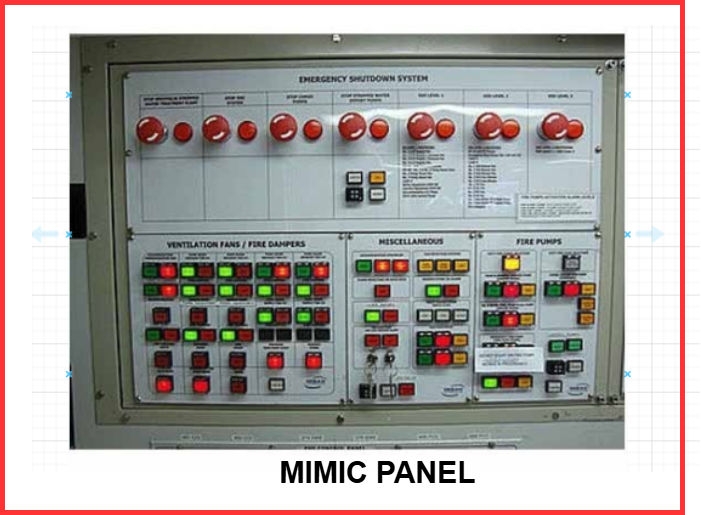
Components of Mimic Control Panels and Cubicles
Mimic control panels and cubicles are designed to provide operators with complete control and monitoring of industrial systems. These panels integrate several essential components to ensure safe, efficient, and reliable operation:
- Schematic Mimic: A front-facing diagram or layout that visually represents the system or process being controlled. This schematic allows operators to quickly understand the flow of operations and identify critical points in real time.
- Lamps and Indicators: High-visibility lamps and status indicators display the operational condition of various system elements. They provide instant feedback, helping operators monitor processes and respond promptly to any abnormalities.
- Switches: Manual switches and pushbuttons enable operators to control, adjust, or override the status of equipment as needed. These are essential for performing local operations, emergency shutdowns, or testing procedures.
- Alarm Annunciators and Fault Recording Equipment: Integrated alarms alert personnel to faults, abnormal conditions, or safety hazards. Fault recording equipment captures events for later analysis, assisting in preventive maintenance and improving overall system reliability.
- Internal Wiring and Equipment Mounting: Mimic panels feature organized internal wiring and secure mounting of equipment, both on the front and inside the cubicle. This ensures smooth operation, easy access for maintenance, and reduced downtime.
By combining these components, mimic panels and control cubicles provide operators with a centralized, intuitive, and efficient platform for managing complex industrial systems, enhancing both safety and operational efficiency.
Mimic Panel Used in Fire & Gas Applications
A mimic panel designed for fire and gas applications provides a clear, visual representation of the installation layout and equipment, allowing personnel to quickly assess any fire or gas hazards. For optimal safety, mimic panels should be installed in easily visible locations, with building-mounted panels ideally positioned near main entrances for quick access.
These panels are equipped with indicator lamps to signal the presence of fire or gas leaks, along with pushbuttons or switches for initiating plant shutdowns or manually activating fire suppression systems. Additionally, a mimic panel can display the operational status of critical fire and gas equipment, such as fire water pumps, foam systems, and emergency devices. To prevent accidental activation, critical pushbuttons are often protected with guards or covers.
One common design for mimic panels is a fixed layout, while an alternative approach uses a tile matrix system. This tile-based configuration allows easy modifications, enabling the addition or removal of components by simply changing individual tiles, making it highly flexible for evolving plant requirements.
Mimic Panels and Bus
A mimic panel or mimic bus serves as a visual schematic representation of a system, process, or installation, offering a simplified yet effective way to monitor operations across various industries. These panels provide operators with an immediate understanding of system layouts, operational status, and potential problem areas, making them indispensable for process monitoring, fault detection, and safety management.
Common applications of a mimic panel include:
- Displaying electrical symbols, connections, and specifications on the exterior of large switchgear or control panels for easy identification and operation.
- Representing the layout of a process plant or industrial system to quickly pinpoint faults, breakdowns, or maintenance requirements.
- Monitoring security and access control in industrial or residential complexes, helping staff locate alarms or unauthorized activities in real time.
- Supervising utility distribution systems such as water, gas, or power networks to ensure smooth operation and rapid response in case of disruptions.
Mimic panels are widely utilized across industries including cement plants, railways, petrochemical facilities, power generation stations, public utilities, foundries, distribution centers, laboratories, and many other industrial or commercial setups. By providing a centralized, visual overview of complex systems, mimic panels enhance operational efficiency, safety, and situational awareness for operators.
Types of Mimic Panels
Printed Mimic Panels
The most commonly used mimic panels are printed panels, typically crafted from durable 10mil polycarbonate sheets. These panels can be reverse-printed in customized colors and sizes to clearly represent process flows, equipment layouts, or system status. Printed mimic panels are ideal for applications where visual clarity and flexibility are essential, such as monitoring plant operations, control rooms, or safety systems. The use of high-contrast colors and standardized symbols ensures that operators can quickly interpret the panel even from a distance.
Engraved Mimic Panels
Engraved mimic panels offer a more permanent solution where durability and long-term readability are priorities. Traditionally, a mimic bus or pathway was cut from plastic stock and mechanically attached to the panel using screws.
Today, modern engraved mimic panels often use weatherproof adhesives to secure components, eliminating the need for drilling and allowing for a cleaner, more reliable installation. These panels are particularly suitable for harsh industrial environments, such as petrochemical plants, power stations, or outdoor installations, where resistance to wear, moisture, and chemicals is critical.
Tile Matrix Mimic Panels (Optional Expansion)
An additional type is the tile matrix mimic panel, which uses interchangeable tiles to represent system components. This design allows for easy modifications, enabling the addition or removal of elements without redesigning the entire panel. Tile matrix panels are highly flexible and are commonly used in evolving plants or facilities where layouts may change frequently.
Applications of Mimic Panels
A mimic panel serves as a comprehensive visual representation of an entire process plant, system, or facility, displayed directly on a control desk or operator panel. By providing a clear overview of equipment, pipelines, flow paths, and operational status, a mimic panel enables operators to monitor and control complex processes efficiently from a single location.
Beyond real-time monitoring, mimic panels act as a critical second-level backup, offering operators a reliable reference in case of computer or SCADA system failure. They are extensively used in various industries, including:
- Power Plants: For monitoring turbines, generators, switchgear, and auxiliary systems.
- Petrochemical & Chemical Plants: To visualize process flows, pumps, valves, and safety systems.
- Water & Wastewater Treatment Facilities: For tracking pumps, filtration systems, and distribution networks.
- Manufacturing & Production Lines: To oversee conveyors, assembly lines, and automation systems.
- Fire & Gas Safety Systems: For quick visual appraisal of alarms, suppression equipment, and emergency response systems.
By consolidating critical information in a single visual interface, a mimic panel enhances operational efficiency, improves response times during emergencies, and provides a robust tool for maintenance, troubleshooting, and process optimization.
Conclusion
A mimic panel is an essential tool for industrial process monitoring, offering a clear and immediate visual representation of plant operations, safety systems, and equipment status. Whether used in power plants, petrochemical facilities, manufacturing units, or fire and gas safety applications, mimic panels provide operators with a centralized interface to monitor, control, and respond quickly to system changes or emergencies.
By combining high-visibility indicators, intuitive layouts, and durable construction, mimic panels enhance operational efficiency, improve safety, and serve as a reliable backup to computer-based monitoring systems. Investing in a well-designed mimic panel ensures that complex processes are easier to oversee, faults are quickly identified, and critical decisions can be made in real time, making it an indispensable part of modern industrial control systems.
FAQs on Mimic Panels
A mimic panel in a substation visually represents breakers, transformers, and switches, helping operators monitor the system and respond quickly to faults. It often includes LEDs and can be integrated with PLC or SCADA systems.
A mimic panel diagram is a schematic on the front of a mimic panel showing system layout or process flow using symbols for valves, pumps, or switches, often color-coded for clarity.
Mimic displays, also called mimic panels, are visual interfaces that simplify process monitoring. They feature LEDs and switches to provide real-time updates and improve operational safety.
Mimic panels are widely used in industries like power plants, petrochemical plants, manufacturing, substations, and fire & gas safety systems to monitor and control complex processes.
Mimic panels provide quick visual monitoring, enhance operational safety, allow faster fault detection, and serve as a reliable backup to computer-based control systems.
Read Next: