In the field of industrial automation and process control, an Instrument DataSheet plays a crucial role in ensuring accurate selection, installation, and operation of instruments. Whether you’re an engineer, technician, or procurement specialist, understanding an instrumentation specification sheet is essential for project success.
What is an Instrument DataSheet?
An Instrument DataSheet (also known as an instrument specification sheet or instrument spec sheet) is a detailed document that contains all the important technical and operational information about a specific instrument.
It acts as a key reference for:
- Engineers (for design and selection)
- Vendors (for manufacturing and supply)
- Maintenance teams (for troubleshooting and servicing)
In simple terms, it is a structured document that explains what the instrument is, how it works, and where it is used.
An instrument datasheet typically includes details such as tag number, service description, installation location (line or equipment number), and references like P&ID or drawing numbers. It may also contain process data, calibrated range (if applicable), material of construction, and performance parameters like accuracy and linearity.
For electrical instruments, hazardous area certifications are included, along with any required accessories.
The content of instrumentation data sheets can vary depending on the type of instrument—such as transmitters, switches, gauges, or control valves—since each requires specific technical details.
Purpose of Instrument Datasheet
Once an Instrument Data Sheet is prepared, it is attached to a requisition and shared with multiple vendors for quotation. Vendors respond with various options, including different models, manufacturers, and detailed instrument specification sheets. The instrument engineer then evaluates these offers carefully to identify which options are technically acceptable.
After assessing both technical and commercial aspects, the most suitable instrument is selected and purchased. Following the purchase order, the vendor submits supporting documents and drawings. Based on this information, the instrument data sheet is updated to reflect the final specifications, becoming an “as-built” document that accurately represents the installed equipment.
All finalized instrument data sheets, along with supporting vendor documents, are stored in a document control system or library. These records serve as essential references during construction, operation, and maintenance.
Instrument data sheets are critical to project success. They ensure correct instrument selection, prevent procurement mismatches, and provide clear communication between the client, vendor, and contractor. They also support maintenance, troubleshooting, and act as official project documentation, reducing the risk of costly errors and delays.
Most EPC companies use their own standard instrument datasheet templates, but it is good practice to follow recognized standards such as ISA guidelines. Understanding the difference between a datasheet vs spec sheet further improves documentation quality. Using detailed instrument datasheet templates enhances efficiency, simplifies spare ordering and replacement selection, and ensures smoother project execution.
Instrument Data Sheet Preparation & Key Components
Preparing an instrument data sheet requires inputs from multiple documents and engineering references, along with a clear understanding of its essential components. The process combines technical data collection with structured documentation to ensure accurate instrument selection, procurement, and lifecycle support.
Workflow Inputs for Data Sheet Preparation
The preparation begins with reviewing the P&ID (Piping and Instrumentation Diagram), which provides key details such as tag number, service description, line/equipment number, and drawing reference.
Accurate process data is then gathered, including operating and design pressure, temperature, flow rate, density, viscosity, and fluid type/state. Additional properties like molecular weight and specific heat ratio may be required for gas applications. The extent of required data depends on the instrument type.
These inputs help the instrument engineer determine measurement range, material selection, and instrument rating. Primary sources include the Heat and Material Balance (HMB) and, where limited data is sufficient, the line list.
The project specification defines minimum requirements and standardization practices for instrumentation, ensuring uniformity across the plant. This reduces spare parts variation and simplifies maintenance.
For certain instruments such as control valves, pressure safety valves, orifice plates, and thermowells, detailed calculations are required before finalizing the data sheet to ensure correct sizing and performance.
Consulting a vendor catalog ensures that the selected instrument is commercially available. Skipping this step may lead to procurement issues, design revisions, and potential project delays.
Finally, compliance with applicable codes and standards is verified to ensure alignment with industry and project requirements.
Key Components of an Instrument Data Sheet
A well-prepared instrumentation data sheet typically includes the following sections:
1. General Information
The General Information section of an instrument data sheet provides the basic identification and project-specific details required to uniquely define the instrument within the system. It serves as a reference for all engineering, procurement, and installation activities. This section typically includes:
- Tag Number – A unique identifier assigned to each instrument for tracking and referencing
- Service Description – Describes the function or purpose of the instrument (e.g., pressure measurement, level control)
- Line/Equipment Number – Indicates the associated process line or equipment where the instrument is installed
- Project Name – Specifies the project to which the instrument belongs for proper documentation and traceability
2. Process Data
When selecting an instrument, it is essential to understand key process parameters that define the operating conditions. These typically form part of the Process Data section in an instrument data sheet, which includes:
- Operating Pressure
- Operating Temperature
- Flow Rate / Level / Density
- Fluid Type
In addition to these, other important properties such as fluid state (gas or liquid), design pressure, design temperature, viscosity, and specific gravity may also be required. For gas applications, parameters like molecular weight and specific heat ratio are considered.
However, the exact process data to be included depends on the type of instrument. Not all parameters are relevant for every device, so only the necessary information should be documented to ensure accurate and efficient instrument selection.
3. Instrument Specifications
The Instrument Specifications section defines the performance and functional characteristics of the instrument. It ensures that the selected device meets the required measurement accuracy and operational expectations for the application. This section typically includes:
- Measurement Range – The minimum and maximum values the instrument is designed to measure
- Accuracy – The degree of closeness of the measured value to the actual process value, usually expressed as a percentage
- Repeatability – The ability of the instrument to produce consistent results under the same operating conditions
- Response Time – The time taken by the instrument to react to changes in the measured parameter
4. Mechanical Details
The Mechanical Details section specifies the physical construction and installation-related aspects of the instrument. It ensures compatibility with the process environment and proper mechanical integration within the system. This section typically includes:
- Material of Construction – Defines the material used for wetted and non-wetted parts to ensure durability and compatibility with the process fluid
- Mounting Type – Indicates how the instrument is installed (e.g., panel-mounted, field-mounted, pipe-mounted)
- Enclosure Type (IP Rating) – Specifies the level of protection against dust and water ingress, ensuring suitability for the operating environment
5. Electrical Details
The Electrical Details section defines the electrical requirements and signal characteristics of the instrument. It ensures proper integration with the control system and safe electrical installation. This section typically includes:
- Power Supply – Specifies the required voltage and power type (e.g., 24V DC, 230V AC) for instrument operation
- Output Signal (4–20 mA, HART, etc.) – Defines the type of signal output used for communication with control systems such as PLC or DCS
- Cable Entry – Indicates the type and size of cable glands or entry points required for proper wiring and environmental protection
6. Calibration & Testing
The Calibration & Testing section defines the requirements to ensure the instrument performs accurately and reliably before installation and during operation. It helps maintain measurement integrity and compliance with project standards. This section typically includes:
- Calibration Range – Specifies the range over which the instrument is calibrated to ensure accurate measurement within operating limits
- Test Requirements – Outlines necessary factory and/or site tests (e.g., calibration checks, functional tests) to verify instrument performance and compliance
7. Vendor Information
The Vendor Information section captures details of the selected manufacturer and specific product, ensuring clear identification for procurement, installation, and future reference. It also plays a key role in verifying the commercial availability of the instrument during the data sheet preparation stage.
While preparing an instrument data sheet, it is important to review the vendor catalog to confirm that the selected instrument is readily available in the market. Skipping this step can create challenges during the procurement phase, as the specified device may be difficult to source.
This section typically includes:
- Manufacturer Name – Identifies the vendor or company supplying the instrument
- Model Number – Specifies the exact product model selected for the application
- Remarks – Includes additional notes such as special requirements, deviations, or clarifications
Including accurate vendor information ensures smoother technical evaluation and effective communication with suppliers. If the selected instrument is not available, it may lead to changes in both the instrument design and potentially the overall process design, resulting in engineering rework and possible project delays.
8. Calculation
Certain instruments require detailed engineering calculations to determine their correct size and dimensions before preparing the instrument data sheet. These calculations are essential to ensure proper performance and compatibility with the process conditions.
Typical examples of such instruments include control valves, pressure safety valves (PSV), orifice plates, and thermowells, where accurate sizing directly impacts system efficiency and safety.
9. Project Requirements
Every project follows a defined project specification that outlines the minimum instrumentation requirements. This document also specifies the standards to be applied to all instruments, ensuring consistency across the entire plant.
By maintaining uniform instrument specifications, the project achieves better standardization, which helps reduce the variety of spare parts and tools required. This approach also simplifies maintenance activities and improves overall operational efficiency.
Difference Between Data Sheet and Specification
Both a data sheet and a specification are essential technical documents, but they serve distinct roles in engineering and procurement.
Data Sheet
A data sheet provides detailed, product-specific information about an instrument or device. It explains what the product is and how it performs. It typically includes:
- Technical specifications and design details
- Performance characteristics and operating limits
- Functional capabilities and features
The main purpose of a data sheet is to support instrument selection, installation, and operation by giving a clear understanding of the product’s capabilities.
Specification
A specification defines the requirements a product must meet to be acceptable for a particular project or application. It focuses on what is required, not on a specific product. It generally includes:
- Required materials and dimensions
- Defined performance standards
- Applicable codes, standards, and quality requirements
The purpose of a specification is to ensure consistency, compliance, and quality across all selected products.
Quick Comparison: Data Sheet vs Specification
| Aspect | Data Sheet | Specification |
| Purpose | Describes a specific product | Defines requirements for a product |
| Focus | Actual features and performance | Required standards and criteria |
| Content | Technical details, ranges, capabilities | Materials, standards, performance requirements |
| Usage | Used for selection and evaluation | Used for compliance and standardization |
| Prepared By | Manufacturer / Vendor / Engineer | Client / EPC / Project Team |
| Application | Helps choose the right instrument | Ensures product meets project needs |
- A data sheet tells you what a product can do
- A specification tells you what a product must do
Understanding this difference improves technical clarity, avoids confusion during procurement, and ensures smooth project execution.
Instrument DataSheet Example (Simplified)
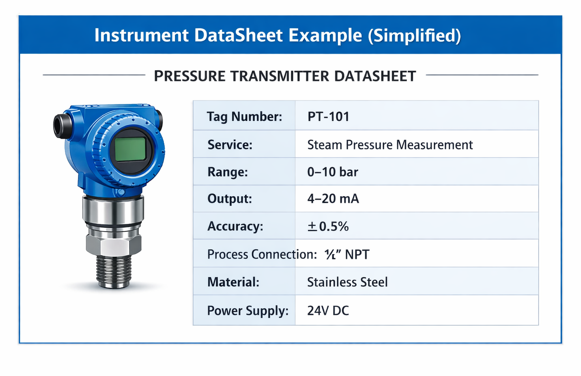
Here’s a basic instrument datasheet example for a pressure transmitter:
Tag Number: PT-101
Service: Steam Pressure Measurement
Range: 0–10 bar
Output: 4-20 mA
Accuracy: ±0.5%
Process Connection: ½” NPT
Material: Stainless Steel
Power Supply: 24V DC
This example shows how an instrument datasheet organizes all critical details in one place.
Instrument DataSheet Standards
An instrument datasheet standard ensures consistency and compatibility across projects. Common standards include:
- ISA (International Society of Automation)
- IEC (International Electrotechnical Commission)
- ISO standards
- Company-specific templates
Following a standard instrument specification sheet format improves communication and reduces errors.
Types of Instrument Data Sheets
Different types of instruments require specific instrument data sheets tailored to their function and application. Each data sheet is customized to capture relevant process, mechanical, and performance parameters.
Common types of instrument data sheets include:
- Pressure Transmitter Data Sheet – Used for instruments measuring pressure in gases or liquids
- Flow Meter Data Sheet – Designed for devices that measure flow rate of fluids
- Temperature Sensor Data Sheet – Covers instruments such as RTDs and thermocouples for temperature measurement
- Control Valve Data Sheet – Includes detailed sizing, actuator, and control characteristics
- Level Transmitter Data Sheet – Used for instruments measuring liquid or solid levels in tanks and vessels
Each instrument specification sheet is developed based on the instrument type, process conditions, and application requirements. This customization ensures accurate selection, proper installation, and reliable operation of the instrument within the system.
Best Practices for Creating Instrumentation Data Sheets
To develop accurate and reliable instrumentation data sheets, it is important to follow certain best practices that ensure consistency, clarity, and usability across the project lifecycle:
- Use Standardized Templates – Adopt consistent data sheet formats (company or industry standards) to maintain uniformity across all instruments
- Include Accurate Process Data – Ensure all process parameters such as pressure, temperature, and flow are correct and sourced from reliable documents
- Verify Units and Ranges – Double-check measurement units and instrument ranges to avoid errors in selection and operation
- Coordinate with Vendors – Engage with vendors/suppliers to confirm technical feasibility and product availability
- Keep Documents Updated – Regularly revise the data sheets to reflect final specifications and maintain them as as-built documents
Following these practices improves instrument selection accuracy, reduces engineering errors, and ensures smooth procurement, installation, and maintenance.
Who Benefits from a Well-Prepared Instrument Data Sheet
A properly developed instrument data sheet is a central document that supports multiple disciplines across a project. It ensures clarity, consistency, and efficiency from design to maintenance.
1. Mechanical (Piping) Designers
For piping designers, the data sheet is essential to develop accurate layouts and avoid installation issues. It helps them to:
- Represent in-line instruments (e.g., flowmeters, control valves) correctly in piping drawings
- Define face-to-face dimensions for proper pipe spacing
- Identify flange size, pressure rating, and thread types for nozzle-mounted instruments
- Allocate sufficient 3D space in congested areas
- Determine correct insertion length for probe-type instruments
2. Instrument Designers (E&I)
E&I engineers rely on the instrument data sheet to configure installation and electrical details. It enables them to:
- Define wiring configuration (2-wire / 4-wire) and power supply requirements
- Select appropriate contact types (e.g., SPST, SPDT)
- Specify connection sizes and thread standards
- Identify required accessories such as manifolds or mounting brackets
- Prepare hook-up drawings and wiring schematics
3. Automation Engineers
For automation engineers, the data sheet ensures smooth integration with control systems like PLC and DCS. It supports:
- Setting correct signal scaling for analog inputs
- Defining engineering units (°C, bar, m³/h) for accurate HMI display
- Selecting suitable communication protocols (e.g., HART, Modbus, Profibus)
- Ensuring proper interface compatibility with control systems
4. Procurement Engineers
A standardized instrument data sheet simplifies the procurement process by:
- Providing a uniform format for technical evaluation
- Reducing misinterpretation of technical requirements
- Enabling fair vendor comparison using identical specifications
- Supporting efficient and transparent competitive bidding
5. Vendors / Suppliers
For vendors, the data sheet serves as a clear reference to:
- Select the most suitable instrument model from their product range
- Prepare accurate technical and commercial proposals
- Ensure fair evaluation based on consistent selection criteria
6. Maintenance Technicians
During operation, instrument data sheets become valuable tools for maintenance teams. They help to:
- Identify measurement ranges and calibration details during troubleshooting
- Locate exact replacement instruments in case of failure
- Verify mounting and connection requirements during retrofits or upgrades
7. Instrument Engineers
For the instrument engineer, the data sheet is a core working document that helps to:
- Organize application-specific requirements clearly
- Avoid over-specification, reducing unnecessary project costs
- Maintain standardization across instruments
- Perform accurate technical comparisons between vendor offers
- Keep a reliable record of design intent for future reference
A well-prepared instrument data sheet ultimately enhances coordination across teams, minimizes errors, and ensures smoother execution throughout the project lifecycle.
Conclusion
An Instrument DataSheet is a vital document in industrial projects that ensures proper selection, installation, and operation of instruments. Whether referred to as an instrument spec sheet, instrumentation data sheet, or instrument specification sheet, its role remains the same—providing precise and reliable information.
Read Next: