Understanding feedforward vs feedback control is crucial in process industries where maintaining stability and performance is essential. Both methods are widely used, but the difference between feedforward and feedback lies in how they respond to disturbances—one predicts, the other reacts.
Feedback Control
Feedback control is one of the most commonly used strategies in industrial systems. It works by continuously measuring the output and comparing it with the desired set point. Whenever a deviation occurs, corrective action is applied.
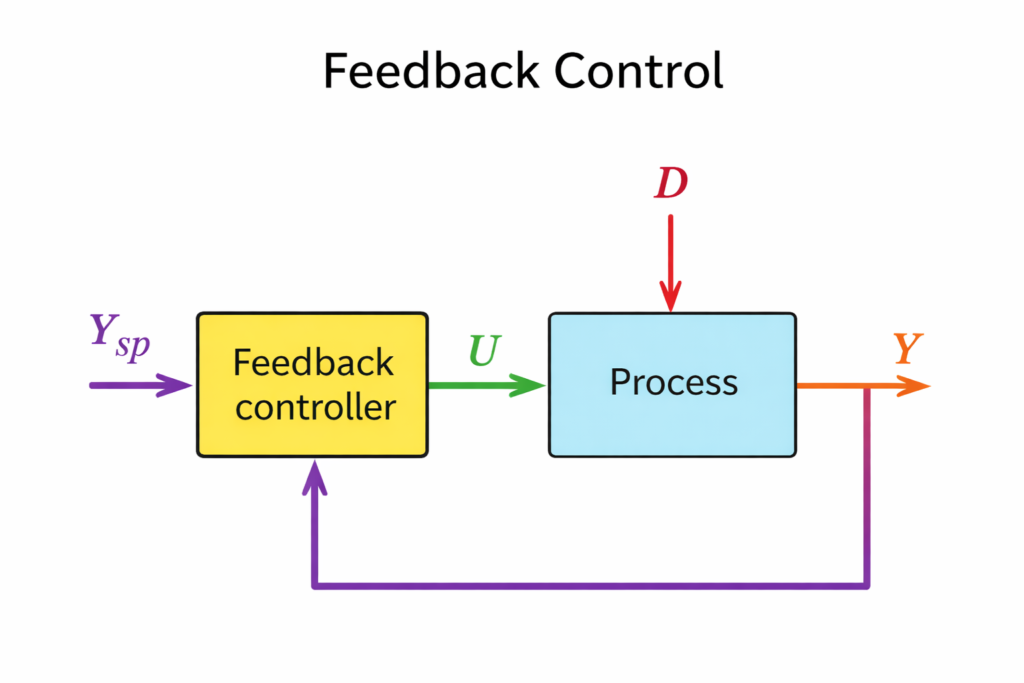
One reason feedback controllers are so popular is their simplicity and reliability. They require very little knowledge of the process, and in most cases, a detailed mathematical model is not necessary. Controllers like PID are highly adaptable, and even if process conditions change, simple tuning adjustments can restore acceptable performance.
However, when comparing feedback vs feedforward, feedback has some limitations. Since it reacts only after an error appears, it cannot prevent disturbances in advance. This means ideal control—where no deviation occurs—is practically impossible.
In systems with long delays or large time constants, feedback may respond too slowly. Additionally, if the output cannot be measured in real time, feedback control becomes difficult or even infeasible.
Feedforward Control
A feedforward control system takes a different approach. Instead of waiting for a deviation, it measures disturbances and acts before they affect the process. This explains what is feedforward control system—a predictive method designed to minimize errors before they occur.
The given diagram illustrates feedforward control, where input is adjusted based on setpoint and disturbances to prevent deviations in output.
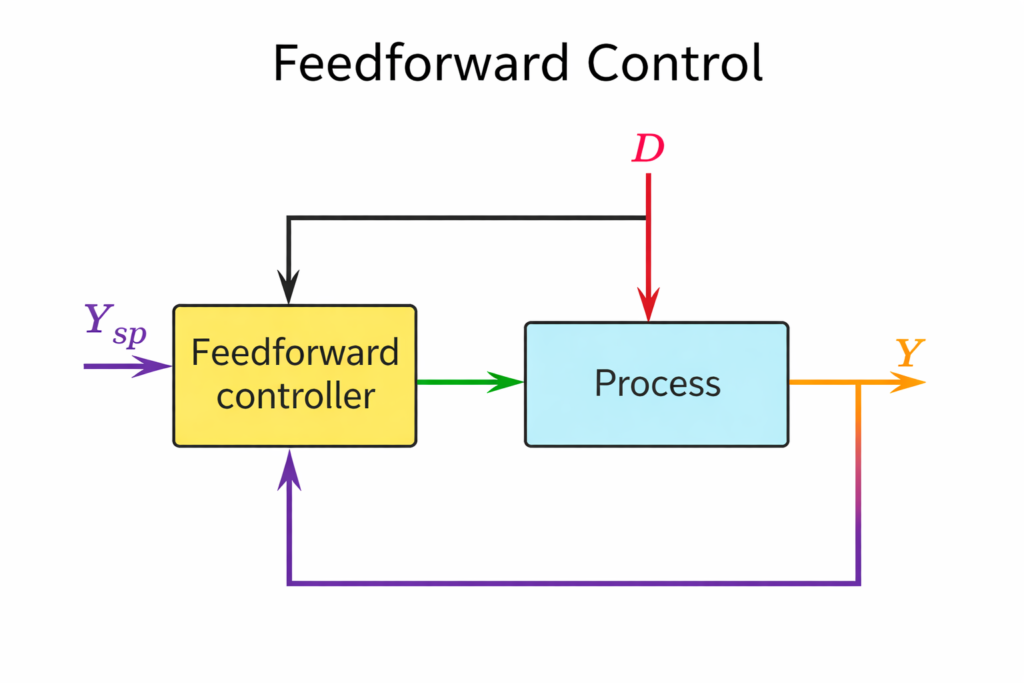
To clarify what is feedforward control, it relies on understanding how input variables influence the output. Because of this, an approximate process model is usually required.
What is a Feedforward Loop?
A feedforward loop monitors disturbance variables and directly adjusts system inputs, avoiding the need to wait for output changes.
Feedforward Control Example
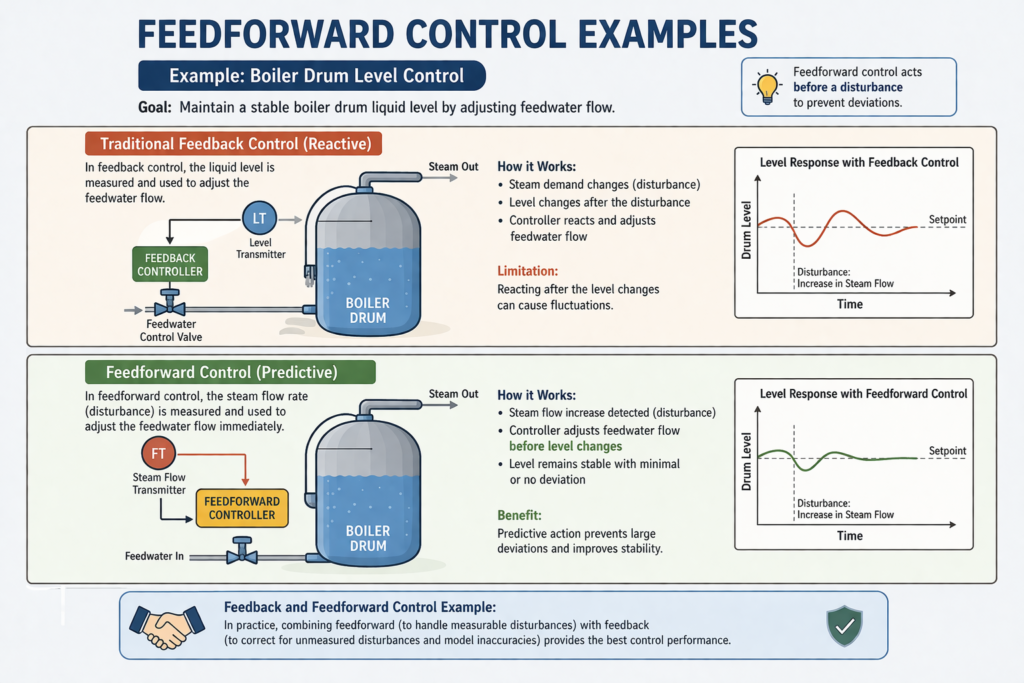
There are several practical feedforward control examples used in industry. A classic feedforward control system example is a boiler drum system.
In a traditional setup using only feedback, the liquid level is measured and used to adjust the feedwater flow. However, rapid changes in steam demand can cause fluctuations because the system reacts only after the level changes.
Feedback Control Example
With feedforward, the steam flow rate is measured as a disturbance. The controller then adjusts the feedwater flow immediately, preventing large deviations. This feedback and feedforward control example clearly shows how predictive action improves system performance.
A boiler drum operating with a traditional feedback control system measures the liquid level and adjusts the feedwater flow accordingly to maintain the desired level.
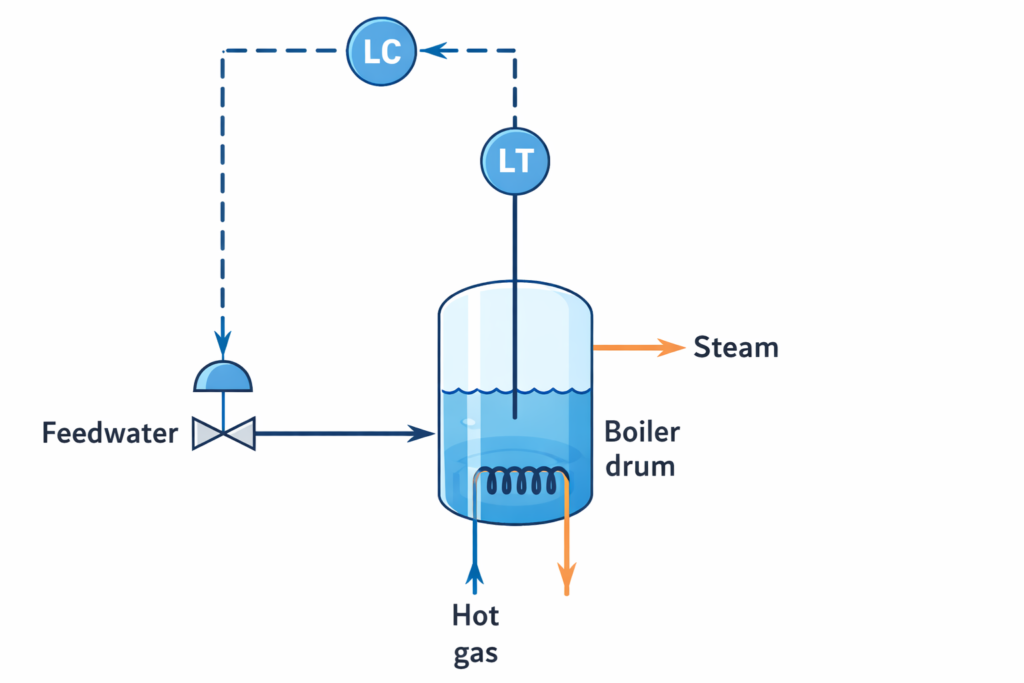
However, this approach can be highly sensitive to sudden variations in steam flow, which acts as a disturbance. Due to the limited storage capacity of the boiler drum, even small and rapid changes in steam demand—often caused by downstream processes—can lead to noticeable fluctuations in the liquid level before corrective action takes effect.
Limitations of Feedforward Control
Although feed forward vs feedback control highlights the speed advantage of feedforward, it also has challenges:
- Disturbance variables must be measured accurately in real time
- A process model is required, and its accuracy directly affects performance
- Perfect feedforward control is difficult to achieve in practice
Because of these factors, feedforward alone is rarely sufficient.
Limitations of Feedback Control
- In feedback control, corrective action is applied only after a deviation occurs in the controlled variable, making perfect control (no deviation during disturbances or set-point changes) practically impossible.
- It does not anticipate disturbances; therefore, it cannot take preventive action against known or measurable disturbances before they affect the system.
- Feedback control may perform poorly in systems with large time constants or delays, and it becomes impractical when the controlled variable cannot be measured in real time.
Combining Feedforward and Feedback Control
In real-world applications, engineers combine both approaches into a feedback feedforward control strategy.
Using feedback control and feedforward control together provides a balanced solution:
- Feedforward reduces the impact of known disturbances
- Feedback corrects errors caused by unknown factors or model inaccuracies
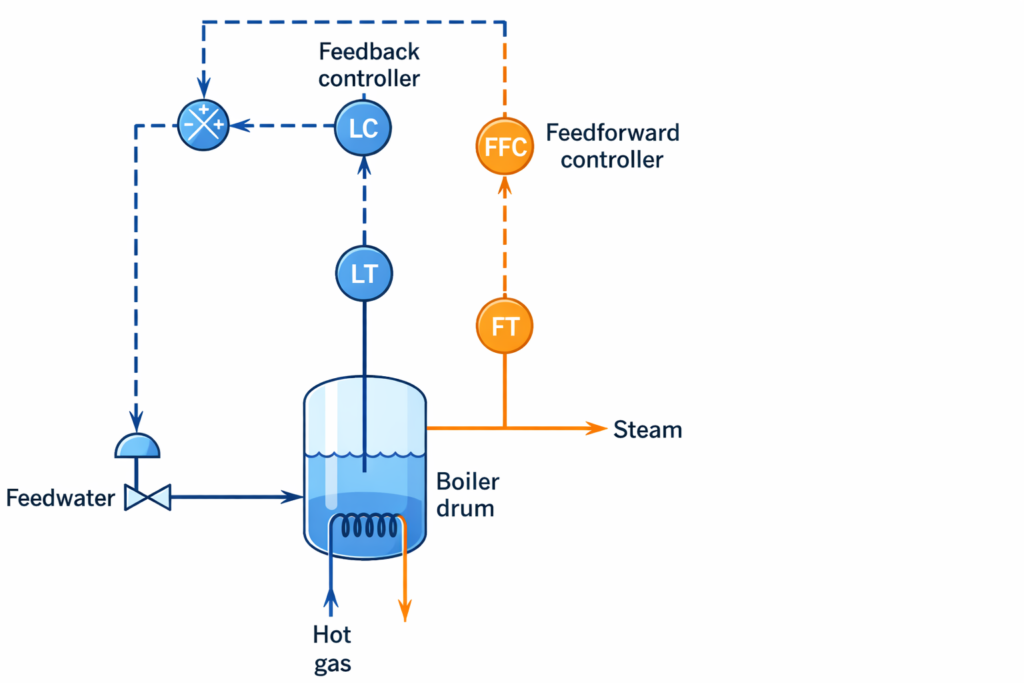
This combination ensures better stability and improved overall efficiency.
Feedforward vs Feedback: Key Insight
When analyzing feedforward vs feedback, the core idea is simple:
- Feedforward prevents errors
- Feedback corrects errors
Understanding feedforward vs feedback control helps engineers design systems that respond quickly while maintaining accuracy.
Tabular Summary: Feedforward vs Feedback Control
| Feature | Feedforward Control | Feedback Control |
| Action | Before disturbance | After disturbance |
| Approach | Predictive | Reactive |
| Speed | Fast | Moderate |
| Accuracy | Model-dependent | High |
| Error Handling | Prevents deviation | Corrects deviation |
Conclusion
The comparison of feedforward vs feedback control shows that both methods have unique strengths. Feedforward offers fast, predictive action, while feedback ensures reliability through correction.
In practice, the most effective systems use both methods together. This integrated approach delivers better performance, especially in complex industrial processes where disturbances are frequent and conditions constantly change.
Read Next: