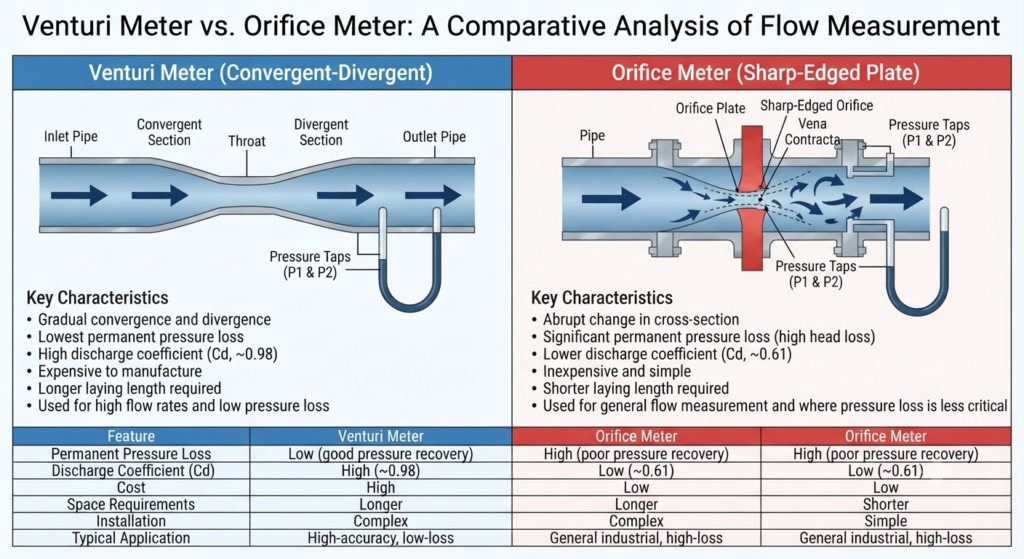
The main difference between Venturi Meter vs. Orifice Meter is the way the flow passage is reduced and how the pressure difference is produced for flow measurement. A Venturi meter uses a gradually converging section, a throat, and a gradually diverging section to create a pressure difference, whereas an orifice meter uses a thin plate with a precisely machined opening installed inside the pipeline. A Venturi meter generally provides higher flow-measurement accuracy and much lower permanent pressure loss, while an orifice meter is more compact, less expensive, and easier to install.
Understanding Venturi Meter vs. Orifice Meter is important when selecting a differential-pressure flowmeter for industrial applications. Both meters measure flow by creating a relationship between fluid velocity and differential pressure, but they differ significantly in construction, pressure loss, installation requirements, maintenance, cost, and long-term performance.
Venturi Meter vs. Orifice Meter Comparison Table
The table below highlights the major differences between Venturi Meter and Orifice Meter.
| Feature | Venturi Meter | Orifice Meter |
| Operating Principle | Measures flow from pressure difference created by a converging section and throat | Measures flow from pressure difference created by an orifice plate |
| Construction | Converging cone, throat, and diverging cone | Thin plate with a precisely sized opening |
| Pressure Loss | Low permanent pressure loss | Relatively high permanent pressure loss |
| Flow Accuracy | Generally high | Good when properly designed and installed |
| Discharge Coefficient | Generally higher and more stable | Lower than a Venturi meter under comparable conditions |
| Installation Space | Requires relatively long straight assembly | Compact |
| Initial Cost | High | Low |
| Maintenance | Relatively low but difficult to remove | Easy plate inspection and replacement |
| Moving Parts | None | None |
| Wear at Primary Element | Low under normal conditions | Orifice edge can wear with service |
| Pressure Recovery | Excellent | Poorer than a Venturi meter |
| Permanent Head Loss | Low | High |
| Suitable Fluids | Clean and dirty liquids, gases, and some slurries | Mainly clean liquids, gases, and steam |
| Flow Range | Relatively wide | Moderate |
| Size Availability | Suitable for medium and large pipelines | Available over a wide range of pipe sizes |
| Space Requirement | Higher | Lower |
| Fabrication | More complex | Simple |
| Replacement Cost | Higher | Lower |
| Typical Application | Water systems, large pipelines, process industries | Steam, gas, water, and general process flow measurement |
| Best Advantage | Low energy loss and high accuracy | Low cost and simple construction |
What Is a Venturi Meter?
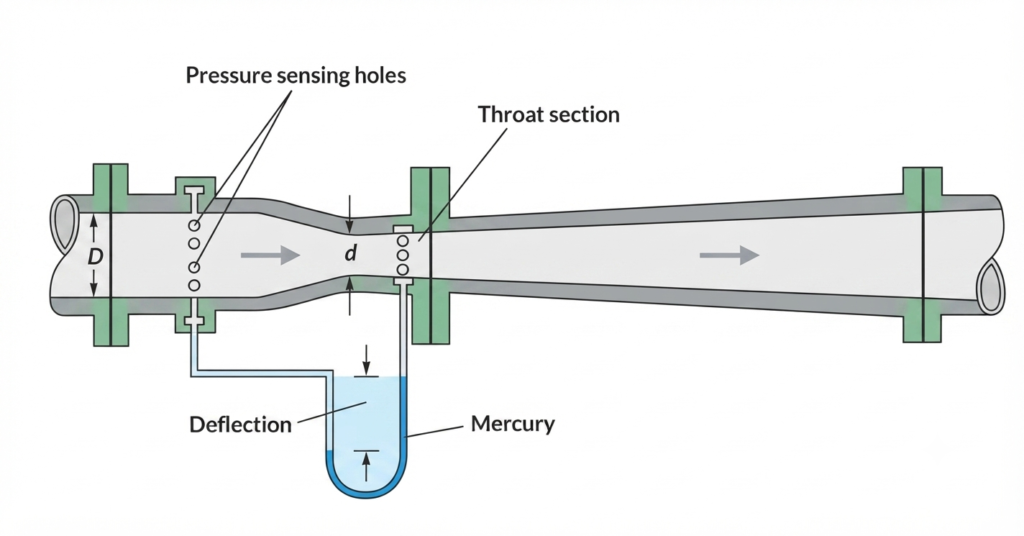
A Venturi meter is a differential-pressure flowmeter used to determine the flow rate of a fluid flowing through a closed pipeline. It consists of a converging section, a narrow throat, and a diverging section.
As the fluid enters the converging section, its flow area decreases and its velocity increases. According to the conservation of energy, the increase in velocity is accompanied by a reduction in static pressure.
The minimum flow area occurs at the throat. The pressure at the throat is therefore lower than the pressure upstream of the meter. The difference between the upstream pressure and throat pressure is measured using pressure taps connected to a differential-pressure transmitter or other pressure-measuring device.
The flow rate can then be calculated from the measured differential pressure.
A simplified flow relationship for a Venturi meter is:
where:
- = volumetric flow rate
- = discharge coefficient
- = throat area
- = differential pressure
- = fluid density
- = ratio of throat diameter to upstream pipe diameter
The Venturi meter recovers a large portion of the pressure that is temporarily converted into velocity at the throat. Consequently, its permanent pressure loss is relatively low.
Main Parts of a Venturi Meter
A conventional Venturi meter consists of three main sections:
- Converging section
- Throat
- Diverging section
The converging section gradually reduces the flow area. The throat provides the minimum cross-sectional area, while the diverging section gradually increases the area and allows the fluid to recover pressure.
Characteristics of a Venturi Meter
Important characteristics of a Venturi meter include:
- It operates on the differential-pressure principle.
- It has no moving parts.
- It contains a converging section.
- It has a defined throat section.
- It includes a diverging section.
- It produces relatively low permanent pressure loss.
- It generally provides good measurement accuracy.
- It has good pressure recovery.
- It can handle relatively high flow rates.
- It is suitable for many liquid and gas applications.
- It requires more installation space than an orifice meter.
- Its initial cost is relatively high.
- It normally has low wear under suitable operating conditions.
How Does a Venturi Meter Work?
The working principle of a Venturi meter is based on the relationship between fluid velocity and pressure.
When fluid enters the converging section, the available flow area gradually decreases. To maintain continuity, the fluid velocity increases.
According to Bernoulli’s principle, an increase in velocity is associated with a decrease in static pressure when other energy terms are appropriately considered.
The fluid reaches its highest velocity and lowest static pressure near the throat.
The pressure difference between the upstream section and throat is measured:
The differential pressure is related to the flow velocity and therefore to the volumetric flow rate.
After passing through the throat, the fluid enters the diverging section. The gradual increase in flow area reduces velocity and allows a substantial portion of the pressure to be recovered.
This gradual geometry is the main reason why a Venturi meter has relatively low permanent pressure loss.
What Is an Orifice Meter?
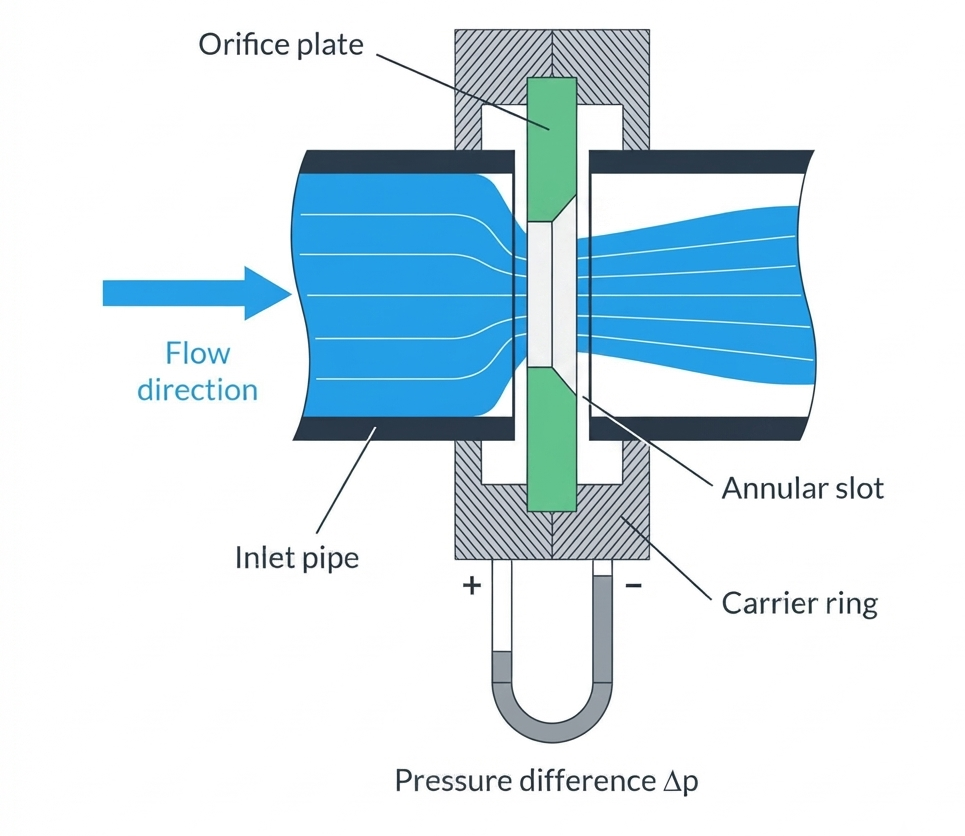
An orifice meter is a differential-pressure flowmeter that uses a thin plate containing a precisely sized circular opening, known as an orifice.
The orifice plate is installed between flanges in a pipeline. As fluid passes through the small opening, its velocity increases and its static pressure decreases.
The pressure upstream of the orifice and the pressure downstream of the orifice are measured through pressure taps. The resulting differential pressure is used to determine the flow rate.
A simplified flow equation is:
where:
- = volumetric flow rate
- = discharge coefficient
- = orifice opening area
- = differential pressure
- = fluid density
- = ratio of orifice diameter to upstream pipe diameter
The orifice plate produces a strong change in velocity and pressure. However, unlike a Venturi meter, it does not provide efficient pressure recovery. A considerable portion of the pressure drop becomes permanent pressure loss.
Main Parts of an Orifice Meter
An orifice flow-measurement arrangement generally includes:
- Orifice plate.
- Upstream pressure tap.
- Downstream pressure tap.
- Flanges or orifice fitting.
- Differential-pressure transmitter.
- Upstream and downstream straight pipe sections.
The orifice plate itself is relatively simple, which is one of the major reasons for its widespread use.
Characteristics of an Orifice Meter
Important characteristics of an orifice meter include:
- It operates on the differential-pressure principle.
- It has no moving parts.
- It uses a thin orifice plate.
- It has a simple construction.
- It has a relatively low initial cost.
- It is easy to replace.
- It requires appropriate upstream and downstream piping.
- It produces relatively high permanent pressure loss.
- The orifice edge can wear over time.
- It is widely used for liquid, gas, and steam measurement.
- Correct installation is important for reliable measurement.
- The discharge coefficient depends on flow conditions and geometry.
How Does an Orifice Meter Work?
An orifice meter works by forcing fluid through a restricted opening.
When fluid approaches the orifice plate, the available flow area suddenly decreases. The fluid accelerates as it passes through the opening.
The increase in velocity produces a decrease in static pressure. Downstream of the orifice, the flow expands and forms a region of minimum effective flow area known as the vena contracta.
The pressure difference between the selected upstream and downstream pressure taps is measured.
The measured differential pressure is then related to the flow rate through an appropriate flow equation and discharge coefficient.
Unlike the gradual geometry of a Venturi meter, the sudden restriction and subsequent flow separation in an orifice meter cause considerable energy dissipation. Therefore, the permanent pressure loss is much higher.
Venturi Meter vs. Orifice Meter: Key Differences
1. Construction
The construction of a Venturi meter is more complex than that of an orifice meter.
A Venturi meter has a converging cone, throat, and diverging cone. These sections are carefully designed to control the flow and improve pressure recovery.
An orifice meter primarily consists of a thin plate with a machined opening.
Therefore, an orifice meter is considerably simpler to fabricate and install.
2. Operating Principle
Both meters use the same basic differential-pressure measurement principle.
The restriction causes the fluid velocity to increase and the static pressure to decrease. The resulting pressure difference is related to the flow rate.
The main difference is how the restriction is created.
A Venturi meter creates a gradual restriction, whereas an orifice meter creates a sudden restriction.
3. Pressure Loss
Pressure loss is one of the most important differences between Venturi Meter vs. Orifice Meter.
A Venturi meter has a relatively low permanent pressure loss because its diverging section allows substantial pressure recovery.
An orifice meter has a considerably higher permanent pressure loss because flow separation and turbulence dissipate more mechanical energy.
For systems where pumping or compression energy is important, a Venturi meter can therefore offer a significant operational advantage.
4. Pressure Recovery
A Venturi meter provides much better pressure recovery than an orifice meter.
The gradual expansion in the Venturi’s diffuser reduces flow separation and converts part of the velocity head back into static pressure.
An orifice meter has no equivalent gradual diffuser. The flow expands abruptly after the restriction, resulting in greater turbulence and energy dissipation.
5. Accuracy
A properly designed and installed Venturi meter can provide high flow-measurement accuracy and stable performance.
Orifice meters can also provide reliable and accurate measurements when the plate geometry, pressure taps, flow conditions, piping arrangement, and calculation method comply with the applicable standard.
In general, a Venturi meter is preferred when high accuracy and low permanent pressure loss are important.
6. Discharge Coefficient
The discharge coefficient accounts for the difference between ideal and actual flow behavior.
For a Venturi meter:
For an orifice meter, the discharge coefficient is also required because actual flow is affected by viscosity, Reynolds number, geometry, pressure taps, and other installation conditions.
The discharge coefficient should therefore be determined using the applicable flow-metering standard or validated calibration data rather than assuming a universal value.
7. Initial Cost
An orifice meter generally has a much lower initial cost.
An orifice plate is relatively inexpensive to manufacture and can be installed using standard flange arrangements.
A Venturi meter requires a specially fabricated body with carefully controlled internal geometry. This makes the initial purchase and installation cost higher.
Therefore, an orifice meter is often selected when capital cost is the primary consideration.
8. Maintenance
An orifice meter has a simple primary element and can be relatively easy to inspect or replace.
The orifice plate can be removed from the pipeline and examined for erosion, corrosion, fouling, or damage.
A Venturi meter normally requires less frequent primary-element maintenance because its smooth internal geometry is less susceptible to sharp-edge damage. However, cleaning or repairing a large Venturi meter can be more difficult and expensive.
9. Wear
The sharp edge of an orifice opening is important to measurement performance. Wear, corrosion, erosion, or deposits around the opening can change the effective geometry and affect the discharge coefficient.
A Venturi meter does not rely on a sharp-edged restriction in the same way. Its smooth internal profile generally provides better long-term resistance to geometric changes under suitable service conditions.
However, abrasive fluids can still cause wear in any flowmeter.
10. Installation Space
An orifice meter is compact and requires relatively little space for the primary element itself.
A Venturi meter is considerably longer because it needs a converging section, throat, and diffuser.
Therefore, an orifice meter is usually easier to install where pipeline space is limited.
11. Energy Consumption
The permanent pressure loss of a flowmeter directly affects the energy required to move fluid through the system.
Because a Venturi meter has low permanent pressure loss, it can reduce the additional pumping or compression energy associated with flow measurement.
An orifice meter produces greater permanent pressure loss and can therefore impose a higher energy penalty.
This difference becomes particularly important in large continuous-flow systems.
12. Suitability for Dirty Fluids
Venturi meters can be advantageous for some dirty-liquid applications because their smooth internal passage has no thin sharp-edged plate projecting into the flow.
Orifice plates can be more susceptible to fouling, blockage, and edge damage when the fluid contains suspended solids or deposits.
However, suitability depends on the specific fluid, particle size, concentration, pipe size, and meter design.
13. Flow Range
Both meters can measure a useful range of flow rates, but their practical performance depends on the design, beta ratio, Reynolds number, differential-pressure range, and transmitter configuration.
A Venturi meter is often selected for large pipelines and high-flow applications where low pressure loss is valuable.
Orifice meters are widely used for general industrial flow measurement because of their simplicity and low cost.
14. Cost of Replacement
Replacing an orifice plate is generally inexpensive compared with replacing a complete Venturi meter.
If the orifice plate becomes damaged or its bore no longer meets the required geometry, the plate can normally be replaced without replacing a large section of the pipeline.
A Venturi meter is a larger and more specialized primary element, so replacement can involve considerably higher equipment and installation costs.
Venturi Meter vs. Orifice Meter: Advantages and Disadvantages
Advantages of a Venturi Meter
A Venturi meter offers several important advantages:
- Low permanent pressure loss.
- Excellent pressure recovery.
- High measurement accuracy.
- Good repeatability.
- No moving parts.
- Smooth internal passage.
- Good resistance to fouling compared with sharp-edged restrictions.
- Suitable for large pipelines.
- Suitable for high-flow applications.
- Long service life under suitable operating conditions.
Disadvantages of a Venturi Meter
The main disadvantages include:
- High initial cost.
- Larger physical size.
- Higher weight.
- More complicated fabrication.
- Greater installation space requirement.
- More difficult replacement.
- Installation can be more expensive.
Advantages of an Orifice Meter
An orifice meter provides several practical advantages:
- Low initial cost.
- Simple construction.
- Compact design.
- Easy replacement of the plate.
- No moving parts.
- Widely standardized.
- Suitable for many industrial fluids.
- Easy integration with differential-pressure transmitters.
- Available for a wide range of pipe sizes.
- Relatively simple fabrication.
Disadvantages of an Orifice Meter
Important disadvantages include:
- High permanent pressure loss.
- Lower pressure recovery.
- Higher energy loss.
- Orifice edge can wear.
- Fouling can affect measurement.
- Accuracy can be strongly affected by installation conditions.
- Requires appropriate straight pipe lengths.
- Pressure-tap arrangement affects measurement.
- Plate inspection may be required in demanding services.
Venturi Meter vs. Orifice Meter: Applications
Applications of Venturi Meters
Venturi meters are commonly used in applications where low pressure loss and reliable flow measurement are important.
Typical applications include:
- Water supply systems.
- Water treatment plants.
- Large pumping systems.
- Cooling-water systems.
- Industrial process pipelines.
- Chemical processing.
- Power plants.
- Irrigation systems.
- Large-diameter pipelines.
- High-flow liquid measurement.
- Certain gas-flow applications.
Venturi meters are particularly attractive in systems where the flow is continuous and the energy cost associated with pressure loss is significant.
Applications of Orifice Meters
Orifice meters are extensively used throughout process industries.
Typical applications include:
- Steam measurement.
- Compressed-air measurement.
- Natural-gas measurement.
- Water measurement.
- Fuel-gas measurement.
- Process-liquid measurement.
- Chemical plants.
- Refineries.
- Power plants.
- Cement plants.
- Manufacturing facilities.
- Utility flow measurement.
Their simple design and relatively low cost make orifice meters a popular choice for general-purpose differential-pressure flow measurement.
Venturi Meter vs. Orifice Meter for Steam Measurement
Both Venturi meters and orifice meters can be used for steam measurement when properly designed and installed.
Orifice meters are widely used for steam because they are relatively inexpensive and standardized. They can be integrated with a differential-pressure transmitter and appropriate temperature and pressure compensation.
A Venturi meter can be advantageous when the steam system cannot tolerate a large permanent pressure drop.
The selection should consider:
- Steam pressure.
- Steam temperature.
- Flow range.
- Pipe size.
- Required accuracy.
- Allowable pressure loss.
- Installation space.
- Capital cost.
- Energy cost.
For a high-flow steam system operating continuously, the lower permanent pressure loss of a Venturi meter may justify its higher initial cost.
Venturi Meter vs. Orifice Meter for Water Flow
Both meters are widely applicable to water flow measurement.
A Venturi meter is particularly useful for large water pipelines because its low permanent pressure loss can reduce energy consumption.
An orifice meter can be attractive for smaller systems or applications where low initial cost is more important than minimizing pressure loss.
For water-treatment plants, pumping stations, cooling-water systems, and large pipelines, the energy-saving advantage of a Venturi meter can become increasingly important.
Venturi Meter vs. Orifice Meter: Which Is Better?
There is no single answer to which meter is better. The selection depends on the operating and economic requirements of the system.
A Venturi meter is generally better when:
- Permanent pressure loss must be minimized.
- High measurement accuracy is required.
- The pipeline diameter is large.
- The flow rate is high.
- Energy consumption is important.
- Long-term operating cost is more important than initial cost.
- Space is available for the longer meter.
An orifice meter is generally better when:
- Low initial cost is important.
- Installation space is limited.
- A standardized differential-pressure measurement arrangement is preferred.
- Easy plate replacement is required.
- Higher permanent pressure loss is acceptable.
- The application is suitable for an orifice plate.
Therefore, the correct choice depends on the complete life-cycle cost rather than only the purchase price.
Venturi Meter vs. Orifice Meter: Energy Loss Comparison
Energy loss is one of the strongest technical arguments for selecting a Venturi meter.
An orifice plate creates a sudden contraction followed by flow expansion. The resulting turbulence and flow separation convert part of the fluid’s mechanical energy into irreversible losses.
A Venturi meter uses gradual contraction and expansion. This design reduces flow separation and allows much better pressure recovery.
Therefore:
Venturi meter → Lower permanent pressure loss → Lower pumping/compression energy requirement
Orifice meter → Higher permanent pressure loss → Higher pumping/compression energy requirement
For a small flow system, this difference may have little economic impact. However, in large industrial systems operating continuously, the energy cost associated with permanent pressure loss can become significant.
Venturi Meter vs. Orifice Meter: Selection Factors
Before selecting between a Venturi meter and an orifice meter, consider the following factors:
1. Required Accuracy
Determine the required flow-measurement accuracy and select a meter that can achieve it under the actual operating conditions.
2. Allowable Pressure Loss
If pressure loss must be minimized, a Venturi meter is generally the stronger choice.
3. Initial Budget
If capital cost is the main constraint, an orifice meter can provide a more economical solution.
4. Pipe Diameter
Large-diameter pipelines often benefit from Venturi-meter technology because reducing permanent pressure loss becomes increasingly valuable.
5. Fluid Properties
Consider:
- Density.
- Viscosity.
- Temperature.
- Pressure.
- Compressibility.
- Suspended solids.
- Corrosiveness.
- Fouling tendency.
6. Flow Range
The expected minimum, normal, and maximum flow rates should be considered when selecting the primary element and differential-pressure transmitter.
7. Installation Space
An orifice meter requires less space than a conventional Venturi meter.
8. Maintenance Requirements
Consider how frequently the primary element may require inspection, cleaning, calibration, or replacement.
9. Life-Cycle Cost
The lowest purchase price does not necessarily mean the lowest total cost.
A Venturi meter may have a higher initial cost but lower operating costs because of its lower permanent pressure loss.
Venturi Meter vs. Orifice Meter: Role of Differential Pressure
In both flowmeters, the differential pressure is the key measured parameter.
The basic relationship is approximately:
Therefore, if the differential pressure increases, the calculated flow rate also increases, but not linearly.
For example, if all other conditions remain constant and the differential pressure increases by a factor of four, the theoretical flow rate increases by a factor of two.
This square-root relationship is important when configuring differential-pressure transmitters and flow calculations.
Venturi Meter vs. Orifice Meter: Role of Beta Ratio
The beta ratio is an important geometric parameter in differential-pressure flow measurement.
It is generally defined as the ratio of the restriction diameter to the upstream pipe diameter:
where:
- = throat or orifice diameter
- = upstream pipe internal diameter
For an orifice meter, represents the orifice bore diameter.
For a Venturi meter, represents the throat diameter.
The beta ratio affects the relationship between differential pressure and flow rate, the discharge coefficient, pressure loss, and overall meter performance.
Venturi Meter vs. Orifice Meter: Maintenance Comparison
| Maintenance Factor | Venturi Meter | Orifice Meter |
| Primary element inspection | Less frequent under suitable conditions | Periodic inspection may be required |
| Replacement | Difficult and expensive | Simple and relatively inexpensive |
| Edge wear | Not dependent on a sharp edge | Orifice edge can wear |
| Fouling | Relatively low with suitable design | Can significantly affect bore |
| Cleaning | More difficult for installed large meters | Plate can generally be removed |
| Mechanical complexity | Higher | Low |
| Maintenance cost | Generally higher when major work is required | Generally lower |
Venturi Meter vs. Orifice Meter: Cost Comparison
The initial cost and operating cost should be evaluated separately.
An orifice meter generally has a lower capital cost because the primary element is a simple plate.
A Venturi meter costs more because its body requires accurately manufactured converging and diverging sections.
However, the lower pressure loss of a Venturi meter can reduce energy consumption over its operating life.
Therefore, a proper economic comparison should consider:
- Purchase cost.
- Installation cost.
- Differential-pressure instrumentation.
- Maintenance cost.
- Replacement cost.
- Pressure-loss energy cost.
- Expected service life.
- Calibration requirements.
A low-cost orifice meter may be the better choice for a small system, while a Venturi meter can become economically attractive for large, continuously operating pipelines.
Standards for Venturi and Orifice Flow Measurement
Differential-pressure flow measurement should be designed, installed, and calculated according to the applicable standards for the specific meter and service.
For orifice plates, ISO 5167 is an important international standard covering differential-pressure devices for flow measurement, including standardized orifice plates.
Relevant standards and engineering specifications should be considered for:
- Primary-element geometry.
- Pressure-tap location.
- Straight-pipe requirements.
- Discharge coefficient.
- Reynolds-number limitations.
- Installation conditions.
- Differential-pressure measurement.
- Flow calculation.
For industrial applications, using a recognized standard is important because apparently small differences in geometry or installation can affect the calculated flow.
Frequently Asked Questions (FAQs)
The main difference between Venturi Meter vs. Orifice Meter is the design of the flow restriction. A Venturi meter uses a gradual converging section, throat, and diffuser, while an orifice meter uses a thin plate with a small opening. The Venturi meter generally has lower permanent pressure loss, while the orifice meter is simpler and less expensive.
An orifice meter generally has much higher permanent pressure loss than a Venturi meter. The Venturi meter’s gradual expansion provides better pressure recovery and reduces irreversible energy loss.
A properly designed and installed Venturi meter can provide high measurement accuracy. An orifice meter can also provide accurate and repeatable measurement when its geometry, pressure taps, installation, and calculation method comply with the applicable standard.
An orifice meter is generally cheaper to purchase and install. Its primary element is a relatively simple plate, whereas a Venturi meter requires a specially fabricated converging section, throat, and diffuser.
A Venturi meter has much better pressure recovery because its diffuser gradually increases the flow area and reduces flow separation.
Read Next:
- Basics of Restriction Orifice (RO) – Types, Applications, and Standards
- Orifice Beta Ratio: Definition, Importance, and Why It Is Limited Between 0.3 to 0.7
- Basics of Orifice Plates
- Orifice Plate Tapping – Types of Orifice Plate Taps Explained
- Coriolis Mass Flow Meter Working Principle
- Orifice Meter: Definition, Construction, Working
- Orifice Discharge Coefficient: Formula, Meaning, Factors and Calculation