A bimetal is a composite material created by bonding two distinct metals into one unified piece. By combining them, the material gains a unique set of characteristics—like enhanced strength, improved flexibility, and sensitivity to temperature changes—that a single metal cannot provide on its own.
Bimetal: Definition and Explanation
A bimetal is created by firmly bonding two different metals so they act as a single unit. Even though they are joined together, each metal retains its own physical and chemical properties. This makes bimetals different from alloys, where metals are mixed and lose their individual identities. The strong bonding also provides durability, structural strength, and long-term reliability in demanding engineering applications.
The idea behind a bimetal is simple but effective—combining two metals to achieve better performance than either could provide alone. By taking advantage of properties such as conductivity, flexibility, and strength, bimetals increase efficiency and allow precise mechanical movement under changing conditions.
In a broader sense, the term bimetallic refers to the intentional use of two metals to improve performance, especially in thermal and structural systems. These layered materials are designed to respond to temperature changes, enabling controlled bending and dependable operation in heat-related applications.
A common example is a bimetal strip. It is made by joining two metals with different rates of thermal expansion. When heated, one metal expands more than the other, causing the strip to bend. This simple principle is widely used in thermostats and automatic switching devices, where accuracy and consistent performance are important.
Composition of a Bimetal Element (with Typical Percentages)
A bimetal element is made by joining two different metals that respond differently to temperature changes. One metal expands more when heated—such as copper or brass—while the other, like steel or certain nickel alloys, expands less. This difference in expansion is what allows the bimetal to bend in a controlled way.
In most cases, the two metals are used in nearly equal proportions, typically around 50%–50%. However, the ratio can vary depending on the application. For greater sensitivity and bending, the high-expansion metal may make up about 60–70%, while the low-expansion metal may be 30–40%.
Common combinations include iron and nickel, brass and steel, copper and iron, and constantan with Invar for high-precision uses. The exact thickness and proportion of each metal are carefully chosen to ensure accurate performance, durability, and consistent thermal response.
These well-designed combinations result in strong, layered materials that are widely used in engineering and industrial systems where reliable temperature-based movement is required.
Key Properties of Bimetals
- Differential Thermal Expansion
The most important property of a bimetal is the difference in expansion rates between its two metals. In many cases, one metal can expand 30–50% more than the other when heated. This causes the material to bend toward the side with lower expansion. - High Temperature Sensitivity
Bimetals react consistently to temperature changes. Even small variations—around 1–2°C—can create noticeable movement, making them highly effective for sensing and control applications. - Mechanical Strength and Flexibility
Bimetals are designed to be both strong and flexible. They can handle repeated bending and often endure thousands to millions of cycles without damage, ensuring long service life. - Wide Operating Temperature Range
These materials can operate efficiently across a broad temperature range, typically from about -50°C to 300°C or more, depending on the metals used. - Controlled Motion Capability
Bimetals can produce different types of motion, including slight bending, spiral movement (in coils), or quick snap action used in switching devices. This makes them versatile in design and application. - Resistance to Environmental Effects
Bimetals are often built to withstand moisture, corrosion, and chemical exposure. This ensures reliable performance even in harsh or demanding environments.
These properties make bimetallic materials highly suitable for precision engineering and temperature-sensitive applications.
How Do Bimetals Work?
The working principle of a bimetal is based on the fact that different metals expand at different rates when the temperature changes. This behavior is described by the coefficient of linear thermal expansion, which indicates how much a material expands per unit length for every degree of temperature increase.
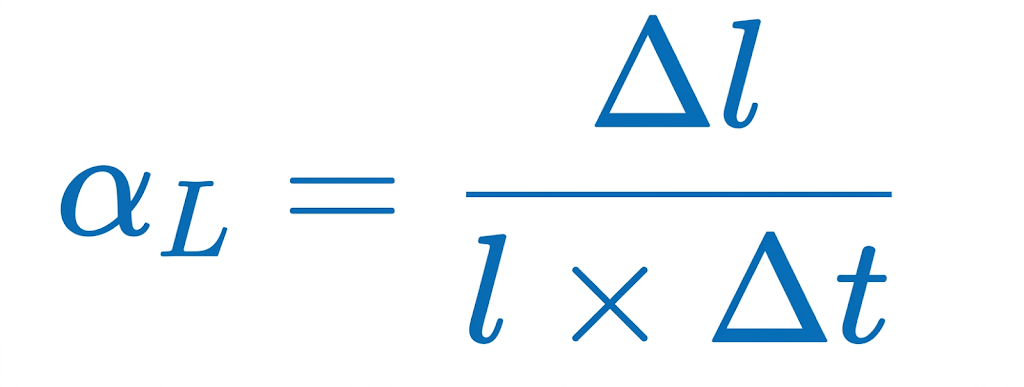
Where:
- αL = Coefficient of linear thermal expansion
- l = Original length
- Δl = Change in length
- Δt = Change in temperature
For reference, typical values of α are:
- Copper ≈ 16–17 × 10⁻⁶ /°C
- Brass ≈ 18–19 × 10⁻⁶ /°C
- Steel ≈ 10–12 × 10⁻⁶ /°C
This difference is what drives the bending action in bimetals.
A typical bimetal consists of two metal strips bonded together. At room temperature, the strip remains flat because both metals are at equilibrium.
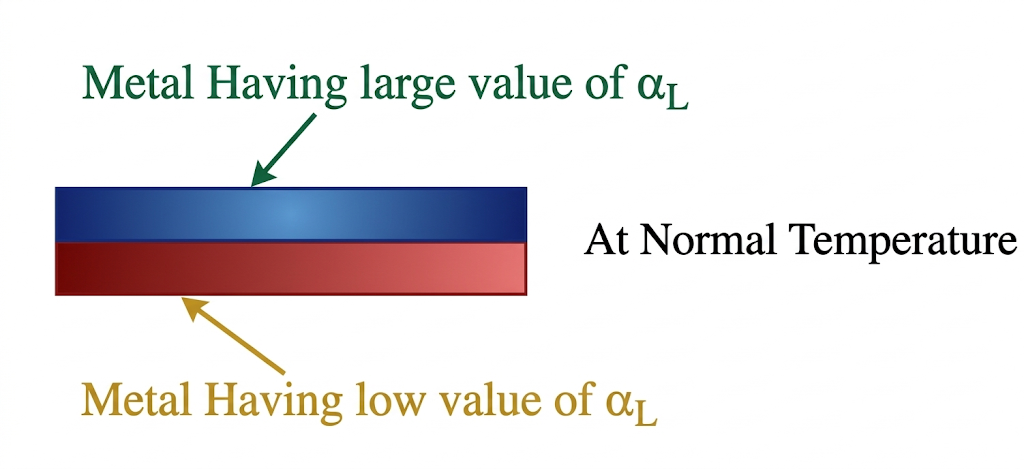
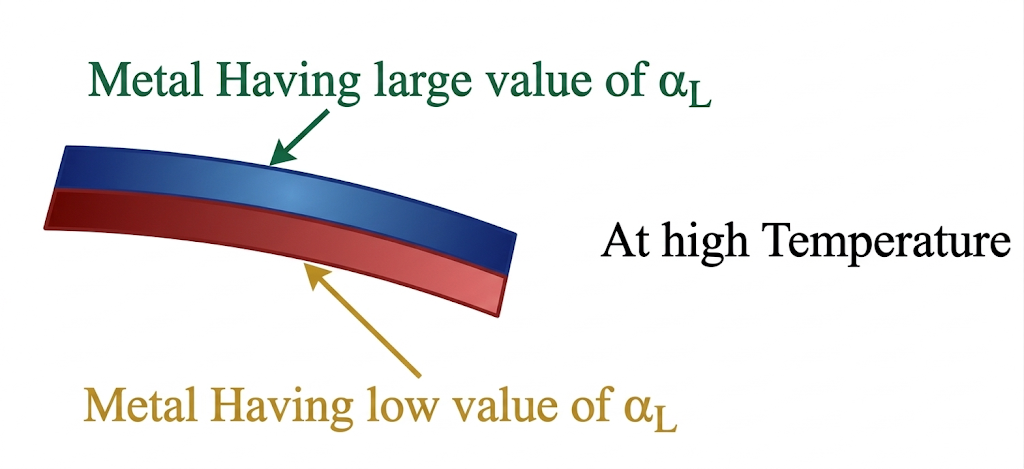
When the temperature increases:
- The metal with the higher expansion rate expands more.
- The metal with the lower expansion rate expands less.
- Since they are firmly bonded, this unequal expansion forces the strip to bend.
The side with higher expansion becomes the outer curve, while the lower-expansion metal forms the inner curve.
When the temperature decreases:
- The metals contract.
- The strip either returns to its original shape or bends in the opposite direction, depending on the temperature drop.
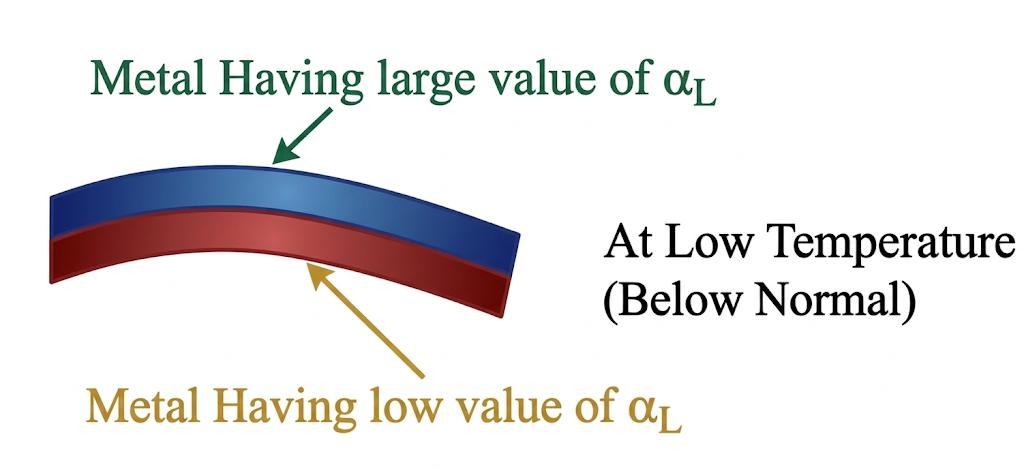
Thus,
- At normal temperature: The strip remains straight.
- On heating: It bends due to unequal expansion (curvature increases with temperature).
- On cooling: It straightens or bends in the opposite direction.
In practical systems, a temperature change of about 50–100°C can produce noticeable deflection, while specially designed strips can respond to even smaller changes.
Common Types of Bimetallic Strip Designs
The design of a bimetallic strip greatly influences its performance, sensitivity, and application. Different shapes are used to achieve specific types of movement and response. The most widely used designs include:
- Disc Type
This design uses circular, bonded metal discs. It is one of the most common types, especially in thermostats and circuit breakers. Disc-type bimetals can produce a quick snap action at specific temperatures (often within ±2–5°C accuracy), making them ideal for automatic switching applications. - Ribbon (Flat Strip) Type
This consists of two flat metal layers bonded along their length. It is simple in construction and provides gradual and predictable bending with temperature changes. Ribbon-type strips are commonly used in measuring devices and can produce small deflections in the range of a few millimeters depending on length and temperature variation. - Coil (Spiral) Type
In this design, the bimetal strip is wound into a spiral or helical shape. This allows it to convert temperature changes into rotational motion, often used in dial thermometers and gauges. Coil designs can amplify movement, sometimes producing angular rotation of 90° or more over a wide temperature range.
Each of these designs offers specific advantages in terms of motion, sensitivity, and response speed. The choice of design depends on the required function—whether it is precise measurement, gradual control, or rapid switching in thermal systems.
Applications of Bimetals
Bimetals are widely used in various industries because of their ability to respond accurately to temperature changes while maintaining strong mechanical performance. Their reliability and simple working principle make them ideal for many thermal control and sensing applications.
Bimetal Thermometers
One of the most common applications of bimetals is in thermometers. In these devices, the bimetallic strip is usually shaped into a spiral or helical coil to increase sensitivity and improve measurement accuracy.
In a typical design, one end of the coiled strip is fixed to the thermometer casing, while the other end is connected to a pointer. This pointer moves across a calibrated scale to display temperature readings. A design of such a thermometer is shown in the figure below.
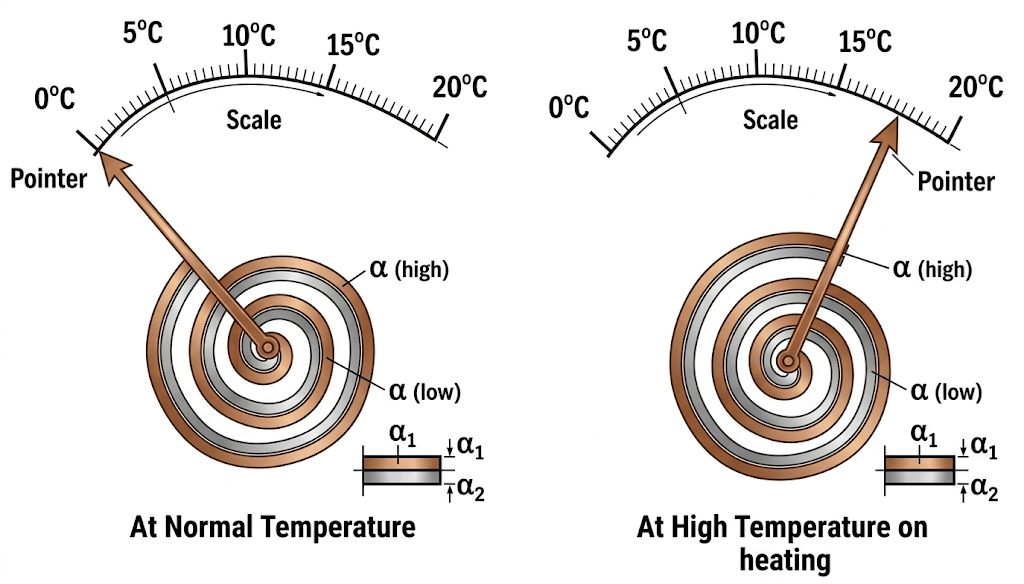
When the temperature changes, the two metals expand or contract at different rates. This difference causes the coil to either tighten or unwind slightly. As a result, the free end of the coil rotates, moving the pointer along the scale.
Depending on the design, bimetal thermometers can measure temperatures ranging from about -50°C to 500°C, with typical accuracy of around ±1–2% of full scale.
Because the scale is calibrated in temperature units, the pointer directly shows the temperature. This simple and efficient mechanism allows bimetal thermometers to provide quick, reliable readings without requiring any external power source.
Read detailed artcile: Bimetallic Strip Thermometer: Constrcution, Working, Types, Applications
Thermostat Switch
Bimetallic strips are essential components in thermostat switches, where they automatically regulate temperature in devices such as electric heaters, irons, refrigerators, and ovens. Their fast response to temperature changes and long-term reliability make them ideal for continuous thermal control.
In many thermostat switch designs, the required heat is generated by the electric current flowing through the strip, which helps activate its movement. A typical arrangement of a bimetallic thermostat switch is illustrated in the figure below.
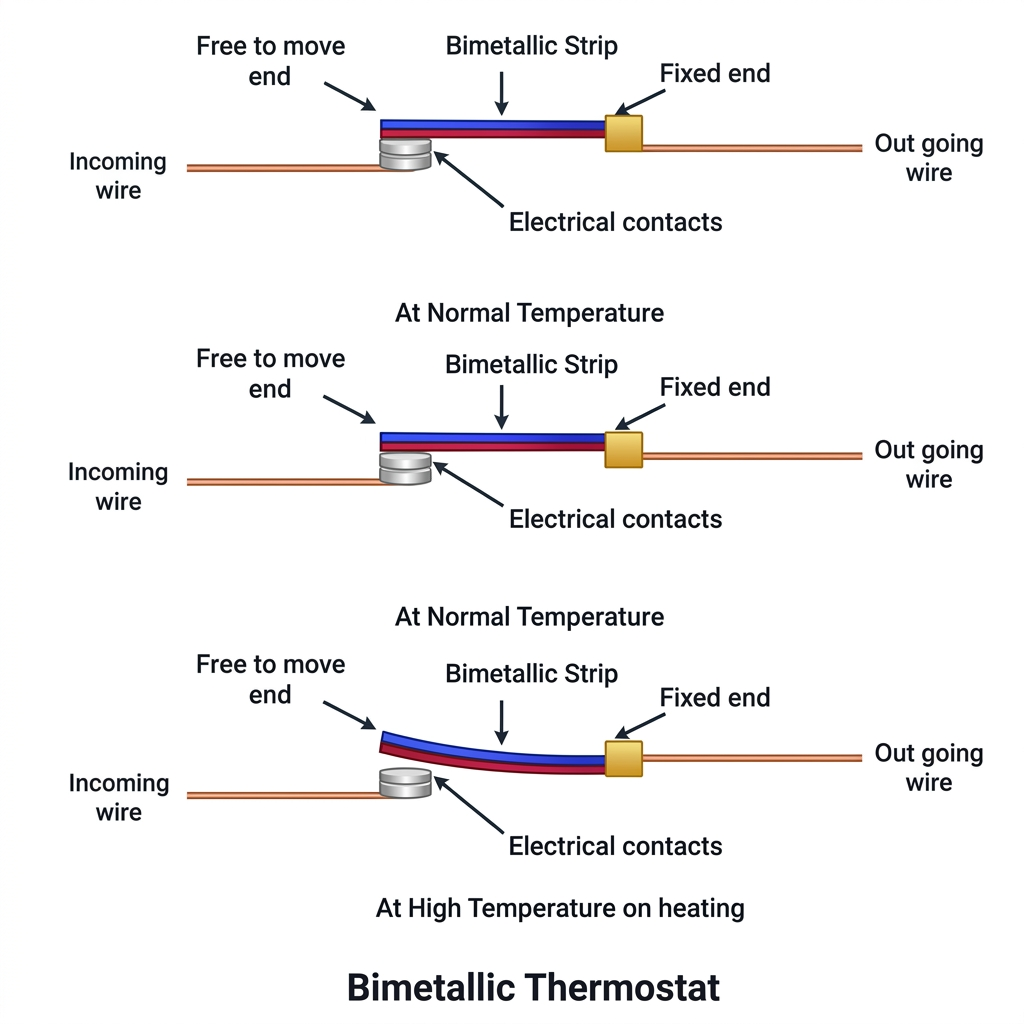
In this setup, one end of the bimetal strip is fixed and connected to the power supply, while the other end is free to move. A movable electrical contact is attached to this free end.
At normal or set temperatures, the movable contact touches a fixed contact, allowing current to flow and keeping the device running. When the temperature rises beyond a preset limit (usually within a control range of about ±2–10°C), the strip bends due to unequal expansion of the two metals. This bending causes the movable contact to separate from the fixed contact, breaking the circuit and stopping the current flow.
As the temperature decreases, the strip gradually returns to its original shape. Once the desired temperature is reached, the contacts reconnect, restoring the circuit and allowing current to flow again. This cycle can repeat thousands of times, enabling the thermostat switch to maintain a stable temperature automatically.
Such systems typically operate within temperature ranges of about 0°C to 300°C, depending on the application, and are widely used because of their simplicity, durability, and ability to function without complex electronic controls.
Protective Devices – Thermal Overload Relay
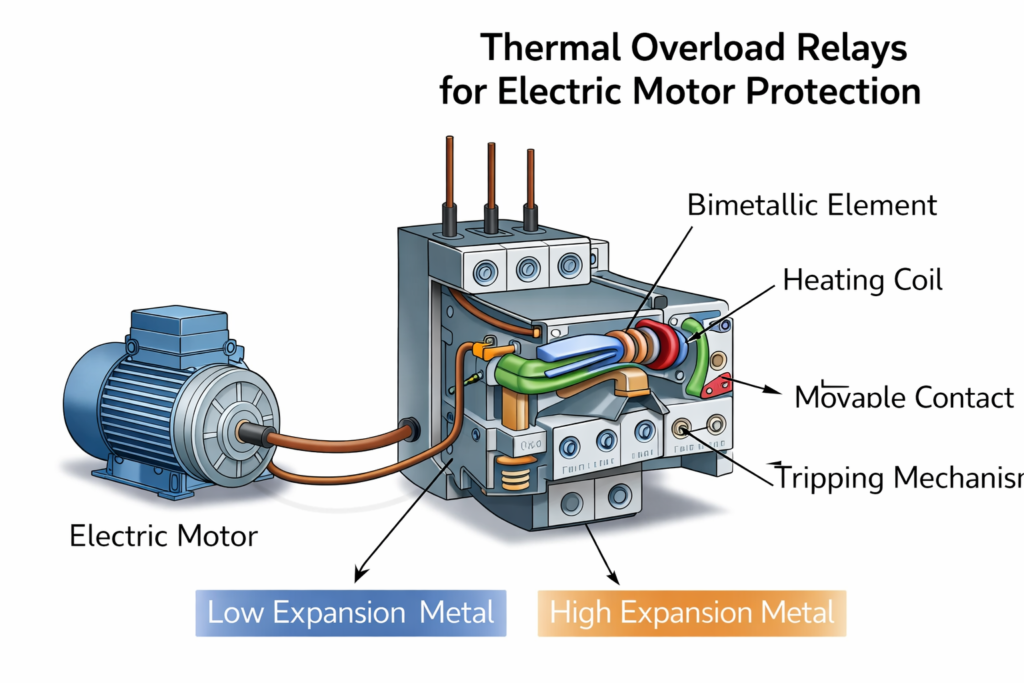
Bimetallic relays are widely used as protective devices to safeguard electrical equipment from damage caused by excessive current. In these systems, the electric current passes through a heating element, which gradually raises the temperature of an attached bimetallic strip.
As the temperature increases, the two metals in the strip expand at different rates. This causes the strip to bend. When the bending reaches a certain limit, it triggers a tripping mechanism that disconnects the power supply. This automatic action protects the circuit from overheating, short circuits, and overload conditions, without the need for manual intervention.
One of the main advantages of bimetallic relays is their simple construction, durability, and self-operating nature. They do not require an external power source and are particularly effective in detecting sustained overcurrent, typically in the range of 110% to 150% of the rated current, which can otherwise cause serious damage.
A key application of this principle is in thermal overload relays used for electric motor protection. When a motor draws excess current over time, the bimetal strip heats up and bends until it trips the relay, disconnecting the motor from the supply. This helps prevent overheating, insulation damage, and extends the life of the motor. These relays are often classified into trip classes (Class 10, 20, or 30), which indicate how quickly they respond under overload conditions.
Another common application is in circuit breakers, where a bimetallic strip automatically interrupts the circuit when the current exceeds safe limits. After cooling, the strip usually returns to its original shape, allowing the system to be reset and used again.
Overall, bimetal-based protective devices provide a reliable, cost-effective, and widely used solution for protecting electrical systems in both industrial and domestic environments.
Clocks
Mechanical clocks are sensitive to temperature changes, which can affect their accuracy. When temperature varies, the elasticity of the balance spring changes, causing the clock to either gain or lose time. Even a small change of 10–15°C can lead to noticeable timing errors.
To reduce this problem, bimetallic strips are used in the clock mechanism.
A common design includes a bimetallic balance wheel, made from two metals that expand at different rates. When the temperature rises, one metal expands more, causing the rim of the wheel to bend slightly inward. This reduces the diameter and increases the oscillation speed, helping correct the clock’s timing.
When the temperature falls, the rim bends outward. This increases the diameter and slows down the oscillations, balancing the effect of temperature change.
This automatic adjustment improves accuracy and reduces timing errors to about ±1–2 seconds per day in well-designed clocks.
Such temperature compensation is especially important in marine chronometers and high-quality mechanical watches, where precise timekeeping is critical.
Overall, the use of bimetallic strips helps maintain stable and reliable clock performance under changing temperature conditions.
Coins
Modern coins are often designed using layered metal structures to reduce production costs and improve durability. Instead of being made from a single metal, many coins use a low-cost core material covered with a thin outer layer of a more valuable metal. This helps maintain appearance while keeping manufacturing economical.
In typical designs, the core may make up around 80–90% of the coin, while the outer coating forms a thin protective layer. This structure also discourages melting, as the overall metal value is lower than the coin’s face value.
Some coins are made as bimetallic coins, consisting of two separate parts—usually an inner core and an outer ring—each made from different metals. Others use trimetallic structures, combining three layers for added strength and security.
These multi-metal designs offer several advantages. They improve resistance to wear and corrosion, enhance visual appearance, and make coins easier to recognize. In addition, the distinct materials and structures provide better protection against counterfeiting.
Overall, the use of bimetallic and layered metals allows coins to be cost-effective, durable, and secure for long-term circulation.
Cans
Many food cans are made from tinplate, which is steel coated with a thin layer of tin. This tin coating acts as a protective barrier, preventing rust and stopping the food from reacting with the steel. Typically, the tin layer is very thin—often less than 1–2% of the total thickness—but it is highly effective in preventing corrosion.
The tin also helps preserve the taste, color, and quality of the food, making these cans suitable for long-term storage. Because of their strength, durability, and low cost, tin-coated steel cans are widely used for packaging foods such as fruits, vegetables, and processed items.
These cans can be considered layered metal structures, similar to bimetallic or trimetallic systems, where different materials are combined to improve performance.
Another common type is the aluminum can, which is lightweight and widely used for beverages. These cans are typically made with a pure aluminum body, while the lid is made from a stronger aluminum alloy. This combination provides both flexibility and strength, allowing the can to withstand internal pressure (up to about 2–3 bar) while remaining easy to open.
One challenge with multi-material cans is recycling, as different layers or components may need to be separated. However, aluminum cans are highly recyclable—up to 90–95% of them can be reused—and can be recycled repeatedly without significant loss of quality.
Overall, the use of layered metals in cans ensures durability, food safety, and cost efficiency, while also supporting sustainable packaging when properly recycled.
Blades
Cutting tools such as bandsaw blades and reciprocating saw blades are often made using a bimetal design. In this construction, the cutting edge is made from high-speed steel (HSS), while the back of the blade is made from high-carbon or alloy steel.
The cutting edge is very hard (about 60–67 HRC), which allows it to stay sharp and cut efficiently. The backing, on the other hand, is more flexible and tough, helping the blade absorb shocks and resist breaking.
This combination improves overall performance. The hard teeth provide clean and precise cutting, while the flexible backing reduces the chance of cracks during use.
Because of this design, bimetal blades can last 2 to 5 times longer than regular blades and perform well even under heavy-duty conditions.
Overall, bimetal blades offer a good balance of strength, flexibility, and durability, making them suitable for demanding cutting applications.
Conclusion
A bimetal is a highly efficient composite material that combines the strengths of two metals into a single structure. Its ability to respond precisely to temperature variations makes it essential in thermostat switches, bimetal thermometers, thermal protection devices, and industrial systems.
With advantages such as durability, reliability, cost-effectiveness, and automatic operation, bimetal technology remains a critical component in modern engineering, manufacturing, and temperature control applications.
Read Next: