A bimetallic strip thermometer is a simple and reliable temperature-measuring device that works on the principle of unequal thermal expansion of two different metals. It is widely used in both domestic and industrial applications due to its durability, low cost, and ability to operate without electricity.
This article covers the construction, working principle, types, and applications of bimetallic strip thermometers, providing a clear understanding of how they function and where they are commonly used.
What is a Bimetallic Strip Thermometer?
A bimetallic strip thermometer is a temperature-measuring device that uses two different metal strips bonded together, such as steel and brass. These metals expand and contract at different rates when the temperature changes. Because of this difference, the strip bends as the temperature rises or falls. This bending motion is then converted into mechanical movement and shown on a calibrated scale to indicate the temperature.
The thermometer works on the principle of thermal expansion, which means materials change their size when the temperature changes. Each metal has its own temperature coefficient, which tells how much it expands or contracts. The unequal expansion of the two metals causes the strip to curve, producing the movement needed for measurement.
Bimetallic thermometers are widely used because they are simple, strong, and inexpensive. They do not require electricity to operate and can measure a wide range of temperatures, typically from below −100 °C to above 500 °C, depending on their design.
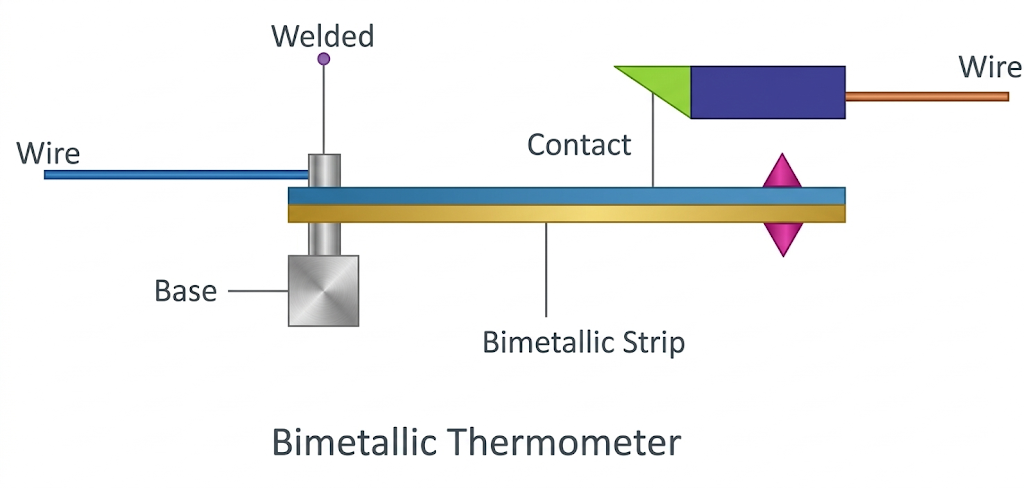
Construction & Theory of a Bimetallic Thermometer
A bimetallic strip thermometer is made by joining two thin strips of different metals, usually by welding them together at one end. The bonding is strong, so the two metals stay fixed together and do not slide over each other when the temperature changes.
Each metal expands or contracts differently because they have different thermal expansion properties. When the temperature rises, one metal expands more than the other, causing the strip to bend toward the metal that expands less. When the temperature falls, the strip bends in the opposite direction, toward the metal that expands more.
In most cases, the strip is designed like a cantilever beam—fixed at one end and free at the other. The free end moves as the strip bends, and this movement is used to measure temperature.
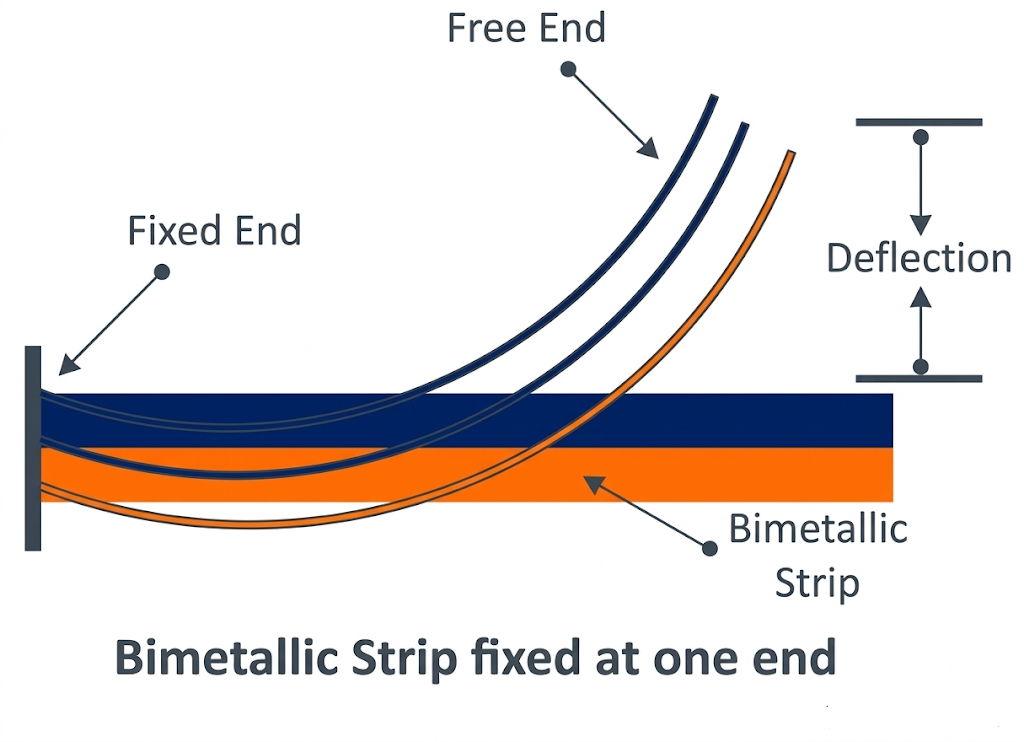
The bending of a bimetallic strip depends on the type of metals used to make it. A longer strip bends more than a shorter one. The amount of bending also increases when the temperature change is larger. However, thicker strips bend less than thinner ones.
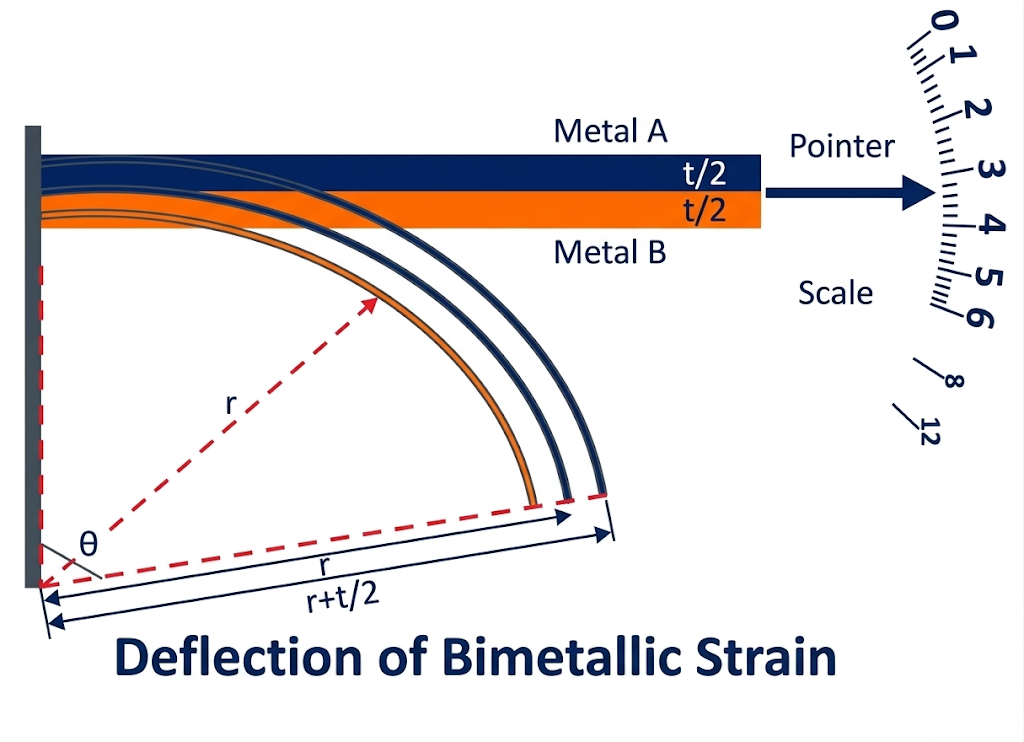
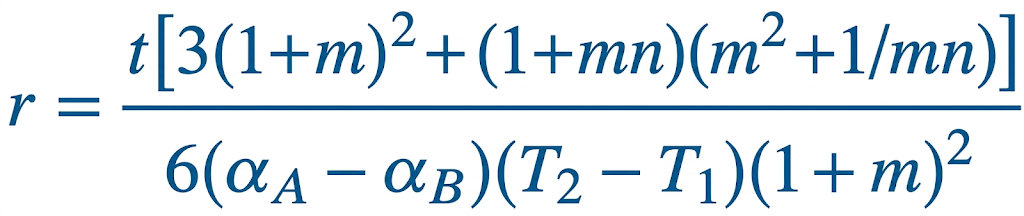
Let’s understand this using a simple formula. Consider a bimetallic strip made of two different metals, A and B. Each metal has its own temperature coefficient. The difference in temperature, T2−T1, represents the change in temperature that causes the strip to expand.
image
Where, t – the total thickness of the strip
n – the ratio of moduli of elasticity = EB/EA
m – the ratio of the thickness
T2 – T1 – change in temperature
tA, tB – the thickness of metal A and metal B.
αA, αB– the thermal coefficient of expansion of metal A and B.
The expansion makes the strip bend into a smooth circular arc. The radius of this arc can be calculated using the formula given below.
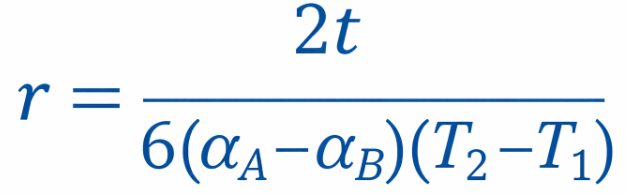
The equation shows that when the temperature increases, the strip bends toward the metal with the lower temperature coefficient. When the temperature decreases, it bends in the opposite direction.
In practical use, both metals are usually chosen with the same thickness and similar elasticity. The modulus of elasticity is a property that shows how well a material returns to its original shape after the force is removed.
The strip is fixed at one end and free at the other. When the surrounding temperature changes, the strip bends into a circular arc.
In many designs, each metal layer has a thickness of t/2.
so,
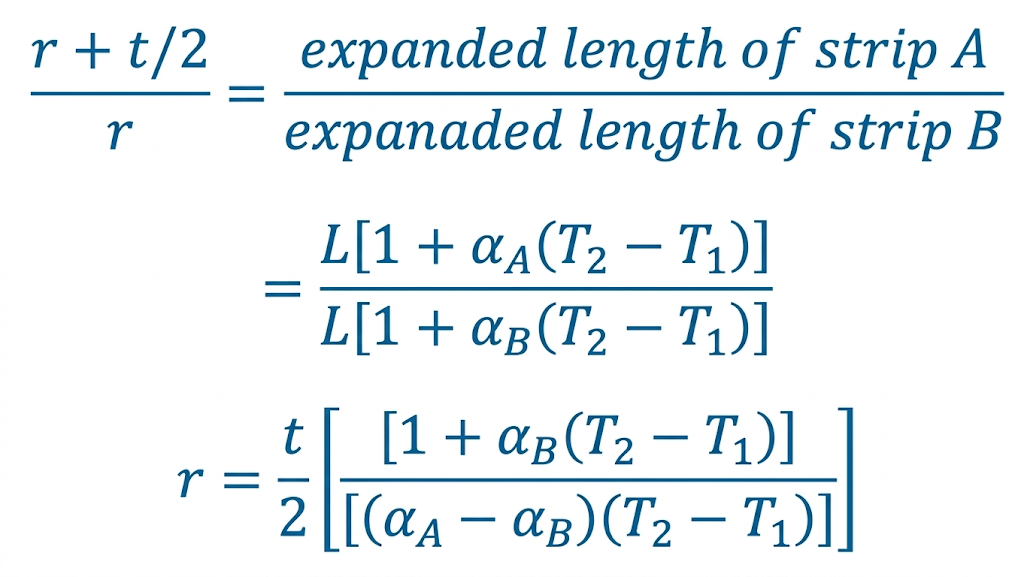
If one of the metals has a very small temperature coefficient, then it expands very little with temperature change. As a result, the bending of the strip is mainly due to the other metal, causing the strip to curve more noticeably toward the metal with the lower expansion.
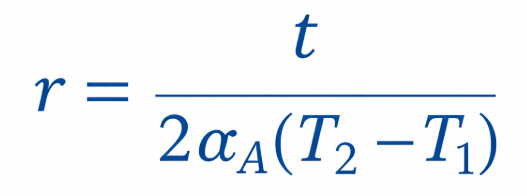
The equation shows that when one end of the strip is fixed, the movement of the free end indicates the change in temperature. However, this type of thermometer is not commonly used in industrial applications because it has low sensitivity and produces only a small deflection.
The sensitivity can be improved by increasing the length of the strip, which allows greater movement for the same change in temperature.
Working Principle of a Bimetallic Thermometer
A bimetallic thermometer operates based on two important properties of metals:
- Thermal Expansion:
Metals expand when heated and contract when cooled. This change in size occurs with every variation in temperature. - Different Expansion Rates:
Each metal has its own temperature coefficient, which means different metals expand or contract by different amounts under the same temperature change.
In a bimetallic thermometer, two metals with different expansion rates are bonded together. When the temperature changes, one metal expands more than the other. This unequal expansion causes the strip to bend or twist.
The bending movement is then converted into mechanical motion, which moves a pointer over a calibrated scale. The amount of deflection is directly related to the temperature change, allowing the device to indicate temperature accurately.
Because of this simple and reliable working principle, bimetallic thermometers are widely used in applications ranging from household appliances to industrial temperature measurement systems.
Types of Bimetallic Strip
There are two main types of bimetallic strip thermometers: spiral and helical. In both designs, the strip is coiled to improve sensitivity and reduce the overall size of the device.
A straight (linear) bimetallic strip produces only a small deflection. Increasing its length can improve sensitivity, but it also makes the thermometer larger and less practical. To overcome this, the strip is shaped into a spiral or helix. This design allows greater deflection while keeping the thermometer compact and easy to use.
Spiral Type Bimetallic Thermometer
A spiral-type bimetallic thermometer uses a thin strip made of two different metals, formed into a flat spiral coil. The inner end of the coil is fixed, while the outer end is connected to a pointer. As the surrounding temperature changes, the metals expand or contract at different rates, causing the spiral to twist. This movement rotates the pointer over a circular dial to indicate the temperature.
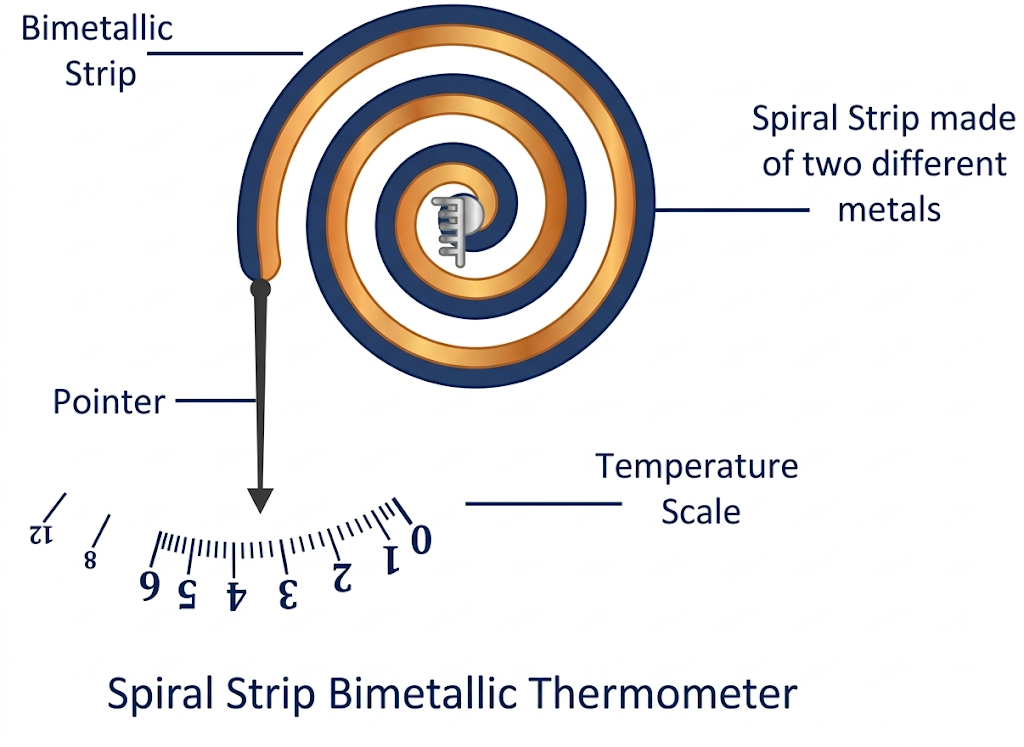
This type of thermometer is commonly used to measure ambient temperature in applications such as room thermometers, ovens, and industrial gauges. The spiral shape increases sensitivity, allowing a larger movement compared to a straight strip while keeping the device compact. Typical temperature ranges for these thermometers are about −50 °C to 400 °C, depending on the design.
The working relies on the thermal expansion of metals, which causes the spiral to deform like a spring when temperature changes. The attached pointer and dial directly display this movement as a temperature reading.
Although spiral thermometers are simple, compact, and cost-effective, they have some limitations:
- The sensing element and dial are combined, so the whole device must be placed in the environment being measured.
- Accuracy depends on the quality and uniform bonding of the bimetallic strip.
- External factors like vibration or mechanical shock can affect performance and lead to errors.
Helical-Type Bimetallic Thermometer
A helical-type bimetallic thermometer uses a strip made of two different metals, formed into a spring-like (helical) coil. One end of the coil is fixed to a shaft, while the other end is free and connected to a pointer. When the temperature changes, the metals expand or contract at different rates, causing the coil to twist. This twisting rotates the shaft, and the pointer moves across a calibrated dial to indicate the temperature.
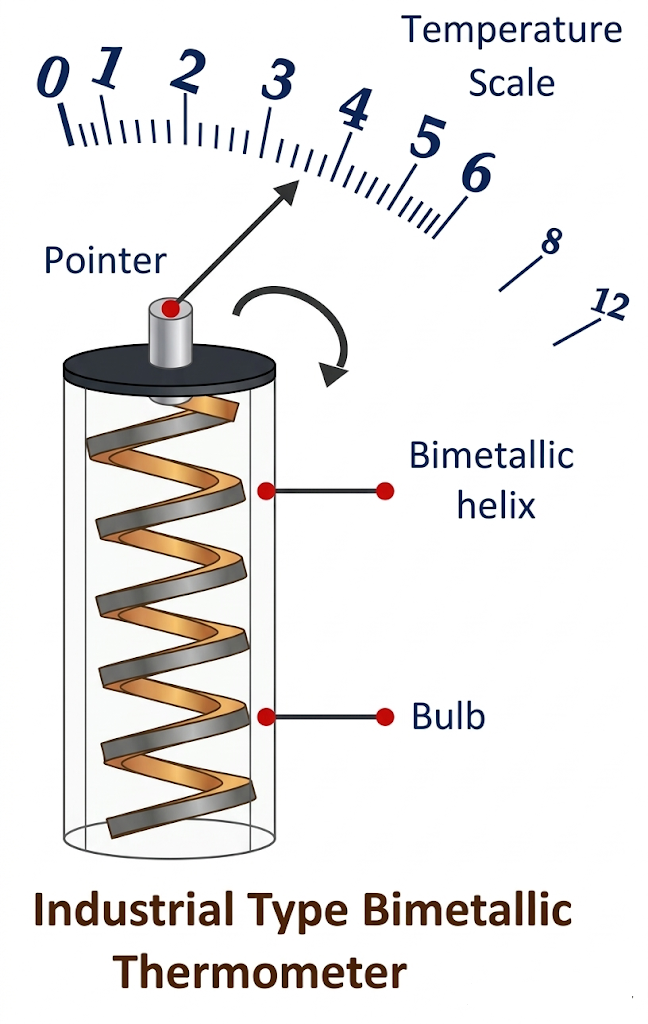
This design is widely used in industrial applications because it provides greater deflection and improved accuracy. The larger movement of the helical coil gives better sensitivity and clearer readings compared to simpler designs.
Compared to the spiral type, the helical thermometer offers several advantages:
- The sensing element and dial can be separated using a capillary tube, making it suitable for remote or hard-to-reach locations.
- It provides higher accuracy and better resolution due to increased mechanical movement.
- It is more resistant to vibrations and mechanical shocks, making it reliable in industrial environments.
Because of these features, helical bimetallic thermometers are preferred where precise and durable temperature measurement is required.
Applications of Bimetallic Strip Thermometer
Bimetallic strip thermometers are widely used across many fields due to their simplicity and reliability. Their common applications include:
1. Temperature Control Systems
These thermometers are often used to control heating and cooling devices. They can automatically switch systems on or off when a set temperature is reached. For example, they are used in electric kettles to stop heating at boiling point (~100 °C) and in fans or heaters to maintain room temperatures between 20–30 °C.
2. Air Conditioning and Refrigeration
Bimetallic thermometers help monitor and regulate temperature in air conditioners, refrigerators, and freezers. They are commonly used in thermostats to maintain desired temperature ranges, such as −20 °C in freezers or 2–8 °C in refrigerators.
3. Industrial Applications
In industries, these thermometers are used to monitor and control temperature in processes like oil refining, plastic molding, metal heating, and soldering. Helical-type thermometers are especially preferred, as they can measure higher temperatures, often up to 500 °C or more, and provide better accuracy.
4. Temperature Measurement and Indication
They are also used to measure and display temperature in liquids, gases, and solid surfaces. Common examples include measuring water temperature in pipelines, monitoring engine surfaces, and checking temperatures in boilers or storage tanks.
Why Bimetallic Thermometers Are Preferred
- Simple and Cost-Effective:
They have a straightforward design and do not require electricity, making them inexpensive and easy to maintain. - Strong and Durable:
Made from metals, they can withstand harsh conditions such as high temperatures, pressure, and mechanical stress. - Reliable Mechanical Operation:
These devices provide direct, analog readings without the need for calibration or electrical components. They are also immune to electromagnetic interference, ensuring stable performance.
Because of these advantages, bimetallic strip thermometers remain a popular choice for both everyday use and industrial applications.
Advantages and Disadvantages of Bimetallic Strip Thermometers
Bimetallic strip thermometers are widely used, but like any measuring device, they have both strengths and limitations.
Advantages
- No External Power Required
These thermometers work purely on mechanical movement, so they do not need electricity or batteries. This makes them reliable in remote or power-free environments. - Low Cost
They are inexpensive to manufacture and purchase, making them suitable for both domestic and industrial use. - Strong and Durable
Made from metals like steel and brass, they are resistant to corrosion, wear, and mechanical damage. They can operate in harsh conditions, including temperatures up to 500 °C in some designs. - Simple Operation
They are easy to use and provide direct readings on a dial. No complex setup, calibration, or electronics are required. - Wide Practical Use
They can measure temperatures roughly from −100 °C to 500 °C, depending on the materials used.
Disadvantages
- Lower Accuracy
These thermometers are less precise compared to digital or electronic types. Errors can occur due to factors like vibration, mechanical wear, and hysteresis. Typical accuracy ranges from ±1% to ±2% of full scale. - Manual Reading Only
The temperature must be read directly from the dial. They cannot easily connect to digital displays, data loggers, or remote monitoring systems. - Limited Sensitivity
Small temperature changes may produce only slight movement, especially in shorter strips, making fine measurements difficult. - Restricted Temperature Limits
Although they cover a wide range, they are not suitable for extremely high temperatures (above ~500–600 °C) or very low cryogenic temperatures, as the metals may lose their properties.
Overall, bimetallic strip thermometers are a practical choice for simple, low-cost temperature measurement. However, for applications requiring high precision or digital monitoring, more advanced thermometers may be preferred.
Conclusion
Bimetallic strip thermometers are simple devices that measure temperature based on the different thermal expansion of two metals. They are made by bonding two metal strips with different expansion rates into a single unit. When the temperature changes, the metals expand or contract unevenly, causing the strip to bend or twist.
This movement is proportional to the temperature change and is used to move a pointer across a calibrated scale, providing a direct temperature reading. Because of their simplicity, durability, and ability to work without electricity, bimetallic thermometers remain widely used in both domestic and industrial applications.
Read Next: