Signals are used to transmit information from one point to another in communication and control systems. Based on how they represent information, signals are broadly classified into analog signals and digital signals. Understanding the difference between these two is fundamental in electronics, instrumentation, and communication engineering.
Analog Signal
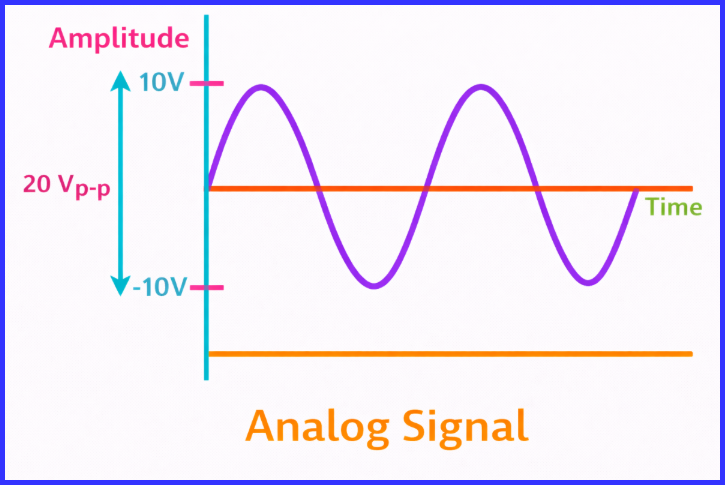
An analog signal is a continuous signal that varies smoothly with time. It can take infinite values within a given range and closely represents real-world physical quantities.
Characteristics of Analog Signals
- Continuous in time and amplitude
- Represents physical quantities such as temperature, pressure, sound, and light
- More susceptible to noise and interference
- Signal degradation increases over long distances
- Difficult to store, process, and reproduce accurately
Examples of Analog Signals
- Human voice
- Microphone output
- Thermocouple voltage
- AM/FM radio signals
- Analog clocks
Advantages of Analog Signals
- Simple and natural representation of real-world signals
- High resolution since signals are not quantized
- Easy to generate using basic electronic components
Disadvantages of Analog Signals
- Highly affected by noise
- Signal quality deteriorates during transmission and amplification
- Less suitable for modern data processing and storage
- Difficult to encrypt and compress
Digital Signal
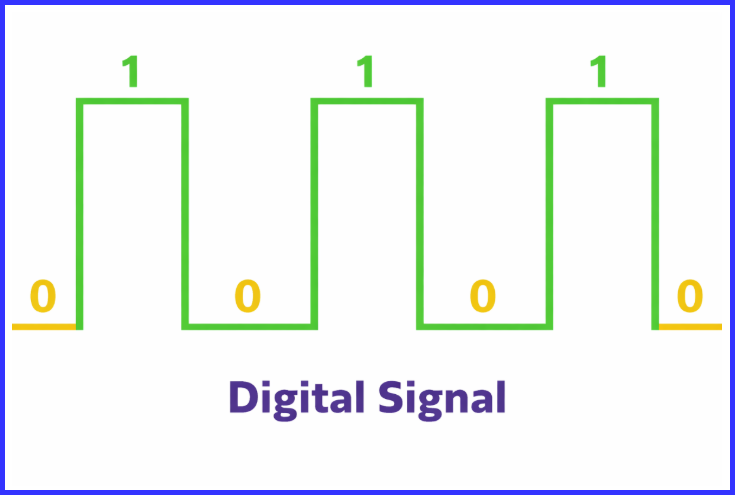
A digital signal represents information using discrete values, typically binary digits 0 and 1. It changes in steps rather than smoothly and is widely used in modern electronic systems.
Characteristics of Digital Signals
- Discrete in time and amplitude
- Limited number of predefined values (usually two levels: HIGH and LOW)
- Highly resistant to noise
- Easy to process, store, and transmit
- Compatible with computers and digital controllers
Examples of Digital Signals
- Computer data
- PLC input/output signals
- Digital sensors
- Mobile phone communication
- USB and Ethernet signals
Advantages of Digital Signals
- High noise immunity
- Easy error detection and correction
- Reliable long-distance transmission
- Simple storage and replication without quality loss
- Supports encryption, compression, and advanced processing
Disadvantages of Digital Signals
- Requires analog-to-digital (ADC) and digital-to-analog (DAC) conversion
- Limited resolution due to quantization
- More complex circuitry compared to simple analog systems
Core Differences Between Analog and Digital Signals
1. Nature of the Signal
- Analog: Continuous waveform
- Digital: Discrete or step-like waveform
2. Representation
- Analog: Represents data using continuously varying voltage or current
- Digital: Represents data using binary numbers (0s and 1s)
3. Noise Sensitivity
- Analog: Highly sensitive to noise and interference
- Digital: Less affected by noise; errors can often be detected and corrected
4. Accuracy and Precision
- Analog: Accuracy degrades due to noise and component aging
- Digital: Maintains accuracy over long distances and time
5. Processing and Storage
- Analog: Difficult to store and process
- Digital: Easy to store, process, compress, and encrypt
6. Transmission Distance
- Analog: Signal quality decreases over long distances
- Digital: Can be regenerated using repeaters, maintaining quality
7. Hardware Requirements
- Analog: Requires amplifiers and filters
- Digital: Requires ADCs (Analog-to-Digital Converters), processors, and logic circuits
Summary Table: Key Differences Between Analog and Digital Signals
| Feature | Analog Signal | Digital Signal |
| Nature | Continuous | Discrete |
| Values | Infinite | Finite (usually 0 and 1) |
| Noise Immunity | Low | High |
| Accuracy | Lower over long distances | High |
| Processing | Difficult | Easy |
| Storage | Not easy | Easy |
| Transmission | Degrades with distance | Maintains integrity |
| Examples | Microphone output, temperature sensor | Computer data, PLC signals |
Conversion Between Analog and Digital
In practical systems, both signals are often used together:
- ADC (Analog-to-Digital Converter) converts analog signals into digital form for processing.
- DAC (Digital-to-Analog Converter) converts digital data back into analog form for output devices like speakers or actuators.
For example, a temperature sensor produces an analog signal, which is converted into digital form for a PLC or microcontroller to process.
Applications of Analog & Digital Signals
Analog Signals
- Audio amplification
- Radio broadcasting
- Analog instrumentation
- Basic control systems
Digital Signals
- Computers and microcontrollers
- Industrial automation (PLC, DCS)
- Telecommunications
- Data storage and networking
Conclusion
Both analog and digital signals play vital roles in modern technology. Analog signals closely represent real-world phenomena but suffer from noise and degradation. Digital signals, on the other hand, offer accuracy, reliability, and ease of processing, making them dominant in today’s communication, computing, and control systems. Most modern systems combine both by converting analog signals into digital form for efficient processing and control.
Read Next: