Understanding the types of Allen Bradley PLC is essential for engineers, technicians, and automation professionals working with industrial control systems. Allen-Bradley, a brand of Rockwell Automation, offers a wide range of PLC controllers designed for small machines to large-scale industrial processes. Each PLC type is developed to meet specific control requirements, making Allen-Bradley one of the most trusted names in industrial automation worldwide.
Introduction to Allen-Bradley PLC
Allen-Bradley PLC controllers are widely used in manufacturing, process industries, power plants, and infrastructure projects. Known for reliability, scalability, and long life cycles, Allen Bradley PLCs support everything from simple relay replacement to advanced motion and safety control. The availability of multiple Allen Bradley PLC types allows engineers to select the best controller based on application complexity, I/O count, and network requirements.
Allen-Bradley PLC History
The Allen-Bradley PLC history dates back to the early days of industrial automation when programmable logic controllers replaced hard-wired relay logic. After becoming part of Allen-Bradley by Rockwell Automation, the PLC product line expanded significantly, introducing modular, compact, and high-performance controllers for modern automation systems.
Allen-Bradley PLC Generations
Over the years, Allen-Bradley PLC generations have continuously evolved to meet the growing demands of industrial automation. Each generation introduced significant advancements in processing power, memory size, communication capability, and system reliability. Early Allen-Bradley PLCs were primarily designed to replace hard-wired relay logic and operated as standalone controllers with limited I/O capacity and minimal networking options.
As industrial systems became more complex, newer PLC generations incorporated faster processors and expanded memory, allowing them to handle advanced logic, motion control, and data-intensive applications. Communication capabilities also improved, shifting from serial-based protocols to high-speed industrial networks such as DeviceNet, ControlNet, and eventually EtherNet/IP.
Modern Allen-Bradley PLC platforms, including CompactLogix and ControlLogix, are designed for plant-wide and enterprise-level integration. These controllers support real-time data exchange, distributed I/O architectures, and seamless connectivity with SCADA, HMI, and MES systems. In recent generations, cybersecurity features such as secure firmware, user authentication, and network protection have become a core focus, ensuring safe and reliable operation in connected industrial environments.
This continuous evolution across generations has positioned Allen-Bradley PLCs as a long-term, future-ready solution for both traditional automation and smart manufacturing initiatives.
Different Allen Bradley PLC series have been launched over time, each addressing specific automation needs. Popular series include MicroLogix, CompactLogix, and ControlLogix, which together cover nearly all industrial control applications.
Types of Allen Bradley PLC
The following are the most commonly used Allen Bradley PLC types, classified based on performance, size, and application scope.
MicroLogix PLC
MicroLogix PLCs fall under the Allen Bradley small PLC category and are designed for compact machines and basic control tasks.
Key Features:
- Fixed I/O configuration
- Compact size and low cost
- Ideal for standalone applications
- Supports basic Ethernet and serial communication
MicroLogix controllers are often chosen when budget and space are limited. They are commonly used in packaging machines, conveyors, and small automation panels.

The controller is programmed using RSLogix 500 software, making it suitable for basic and mid-level automation tasks. It features integrated onboard I/O, eliminating the need for external expansion racks. Input and output modules are internally linked through a ribbon cable connection, which simplifies wiring and reduces installation space.
For communication, the PLC supports RS-232/RS-485 interfaces along with an Ethernet port, enabling reliable data exchange with other devices and networks. The system can handle up to 32 digital I/O points and 6 analog I/O channels, making it ideal for compact control applications. Additionally, the built-in LCD display allows users to monitor system status and perform basic diagnostics directly from the controller.
CompactLogix PLC
CompactLogix PLCs bridge the gap between small and large control systems. These AB PLC controllers support modular expansion and advanced control features.
Key Features:
- Modular Allen-Bradley PLC design
- Supports Ethernet/IP networking
- Integrated motion and safety options
- Uses Studio 5000 software
CompactLogix is widely used in batch processes, OEM machines, and medium-sized automation projects.
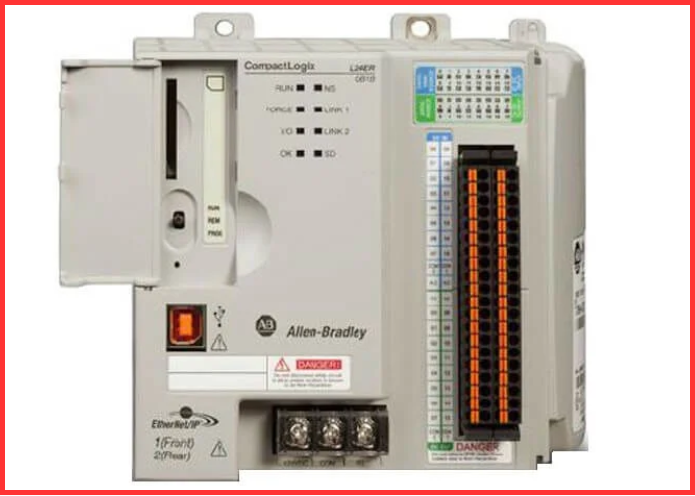
The PLC is equipped with built-in onboard I/O, allowing it to operate without external input/output hardware. While expansion modules can be added to increase the I/O count, the system supports expansion only within defined limits. Programming is performed using RSLogix 5000 software, which provides advanced tools for configuration and control.
This controller does not require a physical rack, making it suitable for compact installations. It supports multiple communication protocols, including Ethernet, ControlNet, DH-485, RS-232, and Modbus, ensuring broad network compatibility. The system can manage up to 30 I/O modules and 16 motion control axes, making it capable of handling complex automation tasks. However, it does not include an LCD display for local monitoring.
ControlLogix PLC
ControlLogix represents the high-end of the Allen Bradley PLC range and is designed for complex, large-scale industrial systems.
Key Features:
- Fully modular architecture
- High-speed processing and large memory
- Advanced redundancy and safety support
- Ideal for plant-wide control
The Allen Bradley PLC ControlLogix platform is commonly used in oil & gas, power generation, automotive plants, and large manufacturing facilities.

This PLC is commonly referred to as a modular PLC because it operates with independent, plug-in I/O modules. Such PLCs are widely implemented in process control, batch operations, and motion control applications where flexibility and scalability are essential.
Programming is carried out using RSLogix 5000 software, enabling advanced control and system integration. The controller is built on a rack-based architecture, allowing multiple I/O and communication modules to be installed according to application needs.
It supports a variety of industrial communication protocols, including EtherNet/IP, ControlNet, DeviceNet, and DH+. Each digital I/O module can handle up to 32 I/O points, while analog I/O capabilities include RTD and thermocouple modules, with support for up to 16 channels per analog module. The controller does not feature an LCD display for local visualization.
CompactLogix Versus ControlLogix
When comparing CompactLogix versus ControlLogix, the choice depends on system size and performance requirements.
In addition to the differences discussed above, CompactLogix and ControlLogix share several common features. Both PLC platforms support symbolic addressing, allowing users to work with meaningful tag names instead of fixed memory locations. They also enable the creation of user-defined data types, which helps standardize programming and improve code reusability across projects.
Both controllers support multiple communication networks, including Ethernet/IP, DeviceNet, ControlNet, and DH protocols for reliable data exchange. Programming and configuration for both platforms are performed using RSLogix 5000 software, providing a unified development environment.
| Feature | CompactLogix | ControlLogix |
| System Size | Medium | Large |
| Architecture | Modular | Fully Modular |
| Redundancy | Limited | Advanced |
| Cost | Moderate | High |
| Application | OEM & Process | Enterprise-scale |
Allen-Bradley PLC Modules and Parts
Allen-Bradley PLC modules form the core building blocks of modular control systems such as ControlLogix and CompactLogix. These systems are assembled using individual hardware components that work together to manage and automate industrial processes. The modular design allows users to customize systems by selecting only the required modules, all of which are mounted within a rack or chassis and programmed using Studio 5000 / RSLogix 5000 software.
Power Supply Module:
The power supply module converts incoming AC power into regulated DC power, ensuring stable operation for the controller and all installed modules.
CPU Module (Controller):
Often referred to as the brain of the PLC, the CPU module executes the control program, manages memory, processes I/O data, and handles communication. Examples include ControlLogix and CompactLogix controllers.
Input/Output (I/O) Modules:
I/O modules interface the PLC with field devices such as sensors and actuators:
- Digital I/O Modules
Used for discrete signals such as ON/OFF status, commonly operating at 24V DC. - Analog I/O Modules
Handle continuous signals like temperature, flow, or pressure, including support for RTD and thermocouple inputs. - Specialty I/O Modules
Designed for specific applications such as motion control, safety systems, and high-speed counting.
Communication Modules:
These modules enable PLCs to exchange data with other controllers, HMIs, drives, and enterprise systems using protocols such as EtherNet/IP, ControlNet, and DeviceNet.
Racks / Chassis and Backplane:
The rack or chassis provides physical mounting for modules, while the backplane bus allows high-speed internal communication between the CPU and installed modules.
Memory:
Memory is integrated within the CPU and is used to store the control program, configuration data, and runtime variables.
Together, these Allen-Bradley PLC modules and parts create a flexible, scalable, and reliable automation platform suitable for both machine-level and plant-wide control systems.
Allen-Bradley PLC Software
Allen Bradley PLC software plays a crucial role in configuration, programming, and diagnostics.
Allen-Bradley PLC Software List
- RSLogix 500 – For MicroLogix PLCs
- Studio 5000 Logix Designer – For CompactLogix and ControlLogix
- FactoryTalk View – HMI and SCADA integration
Allen-Bradley PLC Model Number Structure
Allen-Bradley PLC model numbers, developed by Rockwell Automation, follow a systematic catalog numbering format in which each segment of the part number conveys specific product details. These identifiers help users quickly determine the controller family, module type, functional features, and physical configuration. The general structure typically appears as:
[Product Family Prefix] – [Model or Module Type] – [Optional Features]
Common Allen-Bradley PLC Families and Prefixes
The initial characters or digits in the model number usually indicate the PLC family, which defines the controller’s performance level and intended application.
- 17xx Series Prefix
This numeric range serves as a general Rockwell Automation hardware identifier and is used across multiple PLC and I/O product lines, such as 1756, 1769, and 1747. - Micro800 Series (e.g., 2080)
Designed for entry-level automation, Micro800 controllers are compact and ideal for small, standalone machines and basic control tasks. - CompactLogix Series (e.g., 1769, 5069, 5370)
These are mid-range, modular PLCs that support flexible expansion and are suitable for a broad range of industrial applications. - ControlLogix Series (e.g., 1756)
Built for high-performance and large-scale systems, ControlLogix controllers are used in complex, data-intensive, and mission-critical applications. - SLC 500 Series (e.g., 1747)
A legacy but still widely installed PLC family, commonly found in small to medium-sized control systems. - PLC-5 Series (e.g., 1785, 1771)
One of Allen-Bradley’s earliest PLC platforms, known for its durability and use in large, process-driven environments, now considered legacy technology.
Understanding Allen-Bradley PLC model numbers simplifies product selection, system design, and maintenance, ensuring compatibility across hardware, software, and automation architectures.
Allen-Bradley PLC Latest Model
The ControlLogix 5590 stands as the latest flagship PLC in the Allen-Bradley portfolio. As a member of the ControlLogix family, it delivers higher processing speed, expanded memory capacity, and advanced performance for demanding industrial applications. This controller also features integrated safety functions compliant with SIL 2 and SIL 3 standards, along with edge computing support to enable real-time data processing closer to the machine level.
All configuration and programming are handled through Studio 5000 Logix Designer software, providing a unified environment for complex control systems. For applications requiring a balance between performance and scalability, newer CompactLogix 5480 controllers serve as powerful mid-range solutions, offering flexibility and seamless integration within modern automation architectures.
PLC Programming Allen-Bradley
Allen-Bradley PLC programming is performed using Rockwell Automation development tools such as Studio 5000 Logix Designer for ControlLogix and CompactLogix platforms, or Connected Components Workbench (CCW) for Micro800 controllers. Programming is most commonly done using Ladder Logic, which visually represents control logic through input conditions and output actions.
Engineers design programs by defining inputs (contacts) and outputs (coils) to control machines and processes in industrial environments. Supporting tools like RSLinx are used for communication between the PLC and programming software, while Emulate software allows engineers to test and simulate logic offline before deploying it to actual hardware. Once validated, the program is downloaded to the PLC to control real-world automation systems safely and efficiently.
Allen-Bradley PLC Range and Applications
Allen-Bradley provides a layered PLC product lineup designed to support scalable industrial automation. The range includes MicroLogix for small applications, CompactLogix for mid-level systems, and ControlLogix for large and highly complex operations. These PLC platforms are widely deployed across industries such as manufacturing, food and beverage, energy, and automotive, where they manage everything from individual machines to full plant operations.
Allen-Bradley PLCs offer integrated motion control, built-in safety features, and advanced networking capabilities, including EtherNet/IP communication. Programming and system configuration are performed using Studio 5000 Logix Designer software, enabling seamless integration, efficient development, and high-performance control across diverse automation environments.
Conclusion
Choosing the right types of Allen Bradley PLC is critical for building reliable, scalable, and future-ready automation systems. From MicroLogix for small machines to CompactLogix and Allen Bradley PLC ControlLogix for enterprise-level control, Allen-Bradley offers PLC solutions for every industrial need. Backed by Rockwell Automation, these PLC controllers continue to set industry benchmarks in performance, flexibility, and innovation.
Read Next: