A level transmitter is an industrial device that continuously measures the height of liquids, slurries, or solid materials in tanks, silos, and other process vessels. It uses measurement technologies such as radar, ultrasonic sensing, differential pressure, or guided-wave radar to determine the material level and provide the measurement data to a monitoring or control system.
Function of Level Transmitter
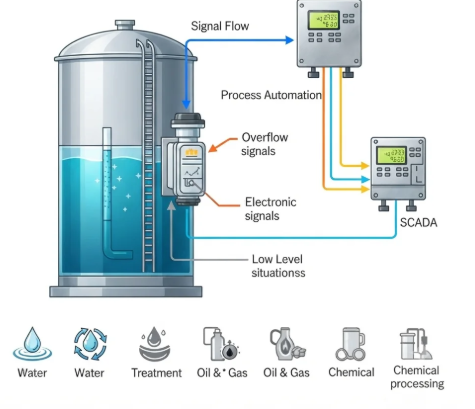
A level transmitter continuously measures the height of liquids, powders, granules, or slurries in tanks, silos, and pipelines. It converts the measured level into an output signal, commonly 4–20 mA, for transmission to a PLC, SCADA, or other process control system. This enables automatic level regulation, tank filling and emptying, material inventory tracking, and high- or low-level alarm functions.
Common Types of Level Transmitters
1. Radar Level Transmitter
A radar level transmitter measures the level of liquids, powders, granules, and slurries by emitting electromagnetic waves toward the material surface and analyzing the reflected signal. Frequency-modulated continuous-wave (FMCW) radar determines the distance using the frequency difference between transmitted and received signals. Radar transmitters are suitable for many demanding applications, including high-temperature, high-pressure, and corrosive environments, depending on the instrument design.
2. Guided Wave Radar Level Transmitter
A guided wave radar transmitter sends electromagnetic pulses along a probe inserted into the material. It determines the level by measuring the time taken for the reflected pulses to return. This technology is useful for measuring liquid levels, liquid interfaces, and certain slurries, particularly where vessel geometry or internal obstructions can affect other measurement methods.
3. Differential Pressure Level Transmitter
A differential pressure (DP) level transmitter determines liquid level by measuring the hydrostatic pressure produced by the liquid column. The measured pressure difference is used to calculate the level when the liquid density and vessel conditions are known. These transmitters are widely used in industrial tanks, boilers, and process vessels, including pressurized tanks when appropriately configured.
4. Ultrasonic Level Transmitter
An ultrasonic level transmitter measures level without direct contact by sending sound waves toward the material surface and measuring the time taken for the reflected echo to return. The measured distance is used to calculate the level. These instruments are commonly used in water treatment plants, wastewater systems, and storage tanks. Foam, vapour, temperature variations, and irregular surfaces can affect their performance.
5. Capacitive Level Transmitter
A capacitive level transmitter detects changes in electrical capacitance as the material level changes around a sensing electrode. It can measure liquids and certain solid materials, provided their electrical properties are suitable for the sensor design. These transmitters are used in tanks, silos, and process vessels where reliable level monitoring is required.
6. Magnetostrictive Level Transmitter
A magnetostrictive level transmitter measures liquid level by detecting the position of a magnetic float along a sensing probe. An interaction between a current pulse and the magnetic field produces a torsional wave, and the instrument calculates the float position from the wave’s travel time. This technology provides high-resolution level measurement and is commonly used in storage tanks and applications requiring precise liquid-level monitoring.
7. Hydrostatic Level Transmitter
A hydrostatic level transmitter measures the pressure exerted by a liquid column and uses it to determine the liquid level. The measurement depends on the liquid density and the gravitational force. These transmitters are widely used in water tanks, reservoirs, wastewater systems, and industrial process vessels.
Working Principles of Level Transmitters
Level transmitters use different sensing technologies to measure the height of liquids, slurries, powders, or bulk solids in tanks, silos, and process vessels. The operating principle depends on the instrument design and the properties of the material being measured.
1. Radar Level Transmitter
A radar level transmitter measures material level by transmitting electromagnetic waves toward the surface and analyzing the reflected signal. The instrument determines the distance between the sensor and the material surface using the signal’s travel time or, in frequency-modulated continuous-wave (FMCW) radar, the frequency difference between the transmitted and received signals.
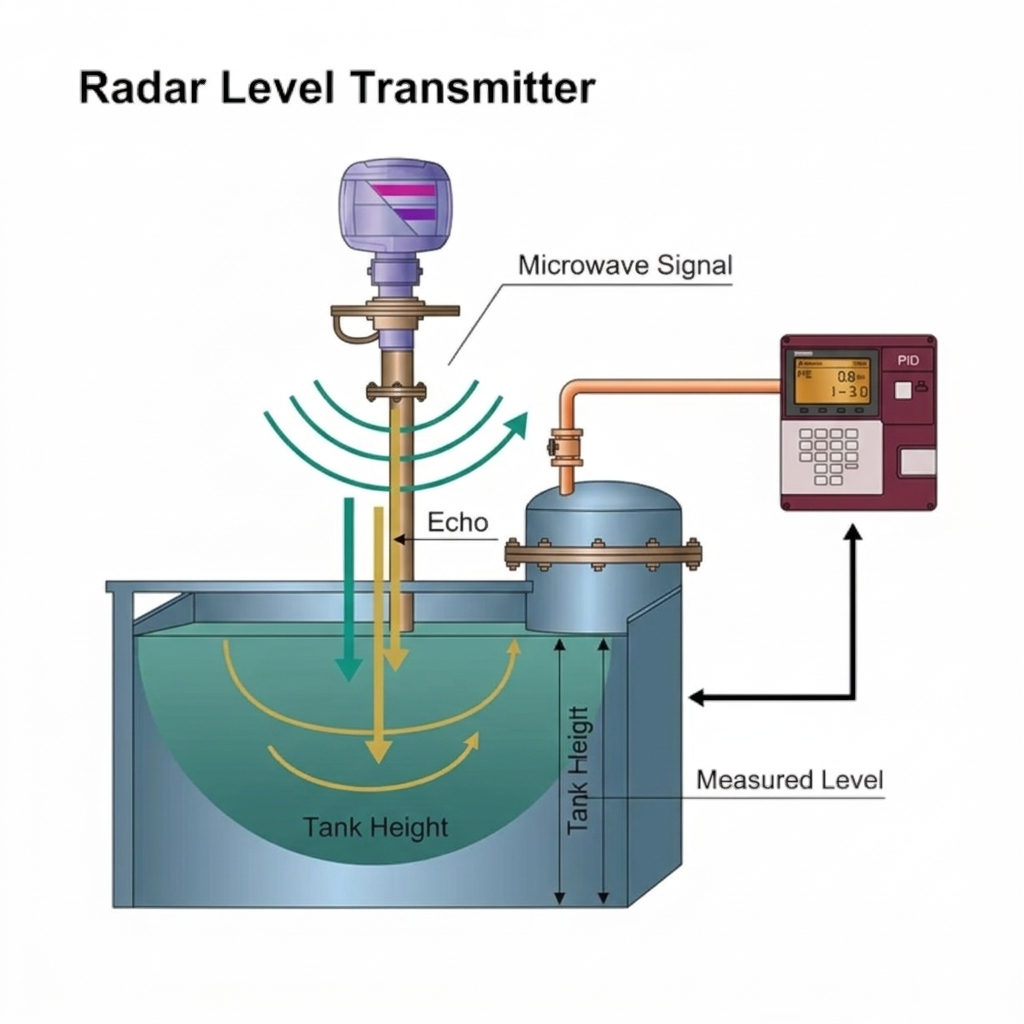
The transmitter calculates the material level by subtracting the measured distance from the configured reference height. Radar instruments are suitable for many applications involving high temperatures, pressure, vapours, or corrosive materials, depending on their design. However, the antenna, frequency, and installation must be appropriate for the process conditions.
2. Guided Wave Radar Level Transmitter
A guided wave radar transmitter sends electromagnetic pulses along a probe, such as a rod or cable, that extends into the tank. When the pulses encounter a change in dielectric properties at the material surface, part of the signal is reflected toward the sensor.
The transmitter measures the pulse travel time and calculates the distance to the surface. It then determines the level using the configured reference height. Guided wave radar is useful for liquid-level measurement, liquid-interface detection, and certain applications involving narrow vessels or internal obstructions. Its performance depends on the probe design and the dielectric properties of the materials.
3. Ultrasonic Level Transmitter
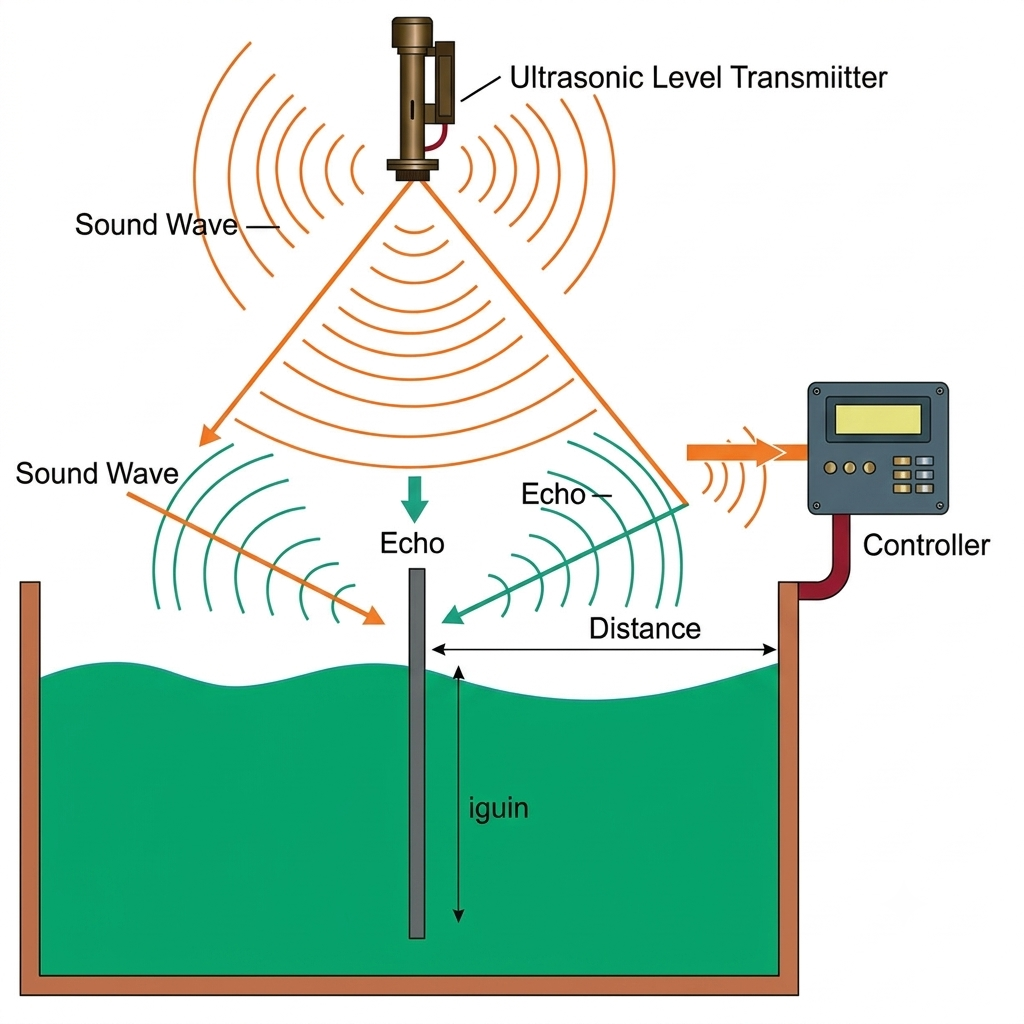
An ultrasonic level transmitter measures level using high-frequency sound waves. The transducer emits an ultrasonic pulse toward the material surface and receives the reflected echo. The instrument calculates the distance from the time taken for the sound wave to travel to the surface and return.
The level is determined by subtracting the measured distance from the installation height.
Ultrasonic transmitters are commonly used in water treatment plants, wastewater systems, and storage tanks. Since they generally provide non-contact measurement, they can reduce maintenance associated with direct contact with the process material. However, foam, vapour, temperature variations, and irregular surfaces can weaken or distort the echo.
4. Differential Pressure Level Transmitter
A differential pressure (DP) level transmitter measures the pressure difference between two points to determine liquid level. In an open tank, the pressure at the bottom increases with the height of the liquid column. The transmitter measures this hydrostatic pressure and uses the liquid density to calculate the level.
For a liquid of constant density in an open tank, the relationship is:
Where:
- is the liquid height in metres.
- is the hydrostatic pressure in pascals.
- is the liquid density in kg/m³.
- is the acceleration due to gravity in m/s².
In a pressurized vessel, a DP transmitter can measure the pressure difference between the bottom and the upper part of the tank to compensate for the vessel’s gas or vapour pressure. These instruments are widely used in process vessels, boilers, and industrial storage tanks. Accurate measurement depends on liquid density, pressure connections, and correct transmitter configuration.
5. Capacitive Level Transmitter
A capacitive level transmitter detects changes in electrical capacitance as the material level changes around a sensing electrode. The electrode and the tank wall, or another electrode, form a capacitor. As the level rises or falls, the proportion of the sensor surrounded by the material changes, affecting the measured capacitance.
The transmitter’s electronic circuit converts this capacitance change into a level measurement and generates an output signal for a monitoring or control system. Capacitive transmitters can measure liquids and certain bulk solids, provided their electrical properties are suitable for the sensor design. Changes in dielectric properties, material buildup, and moisture content can affect measurement accuracy.
6. Magnetostrictive Level Transmitter
A magnetostrictive level transmitter measures liquid level by detecting the position of a magnetic float along a sensing probe. The float moves with the liquid surface and contains a magnet. Inside the probe, an electrical current pulse interacts with the magnetic field, generating a torsional stress wave in the magnetostrictive sensing element.
The transmitter measures the time taken for the wave to reach the detection point and uses this information to determine the float’s position. The measured position corresponds to the liquid level. Magnetostrictive transmitters offer high-resolution measurement and are used in storage tanks and applications requiring precise level monitoring. Their suitability depends on the float design, liquid properties, and installation arrangement.
7. Hydrostatic Level Transmitter
A hydrostatic level transmitter measures the pressure produced by the weight of the liquid column above the sensing element. The pressure increases with liquid height, allowing the transmitter to calculate the level when the liquid density is known.
For a liquid with approximately constant density, the hydrostatic pressure is given by:
Where is the hydrostatic pressure, is the liquid density, is gravitational acceleration, and is the liquid height above the sensing point.
The transmitter converts the measured pressure into a level value and sends the result to a PLC, DCS, or other monitoring system. Hydrostatic transmitters are commonly used in reservoirs, water tanks, wastewater systems, and industrial vessels. Density changes, pressure variations, and incorrect installation can affect the calculated level.
Factors Affecting the Selection of a Level Transmitter
The appropriate technology depends on the application and required measurement performance. Consider the following factors when selecting a level transmitter:
- Material properties: Determine whether the material is a liquid, slurry, powder, or granular solid. Consider density, dielectric properties, viscosity, and corrosiveness.
- Tank geometry: Check the vessel dimensions, internal obstructions, agitators, nozzles, and available mounting locations.
- Operating conditions: Consider process temperature, pressure, vapour, foam, dust, and condensation.
- Measurement requirements: Establish the measuring range, required accuracy, response time, and whether continuous level or interface measurement is needed.
- Installation and maintenance: Assess accessibility, probe mounting, process connections, cleaning requirements, and calibration needs.
- Output and integration: Confirm compatibility with the control system, including 4–20 mA, HART, or other supported digital communication protocols.
- Safety and compliance: Verify the required hazardous-area certification, material compatibility, and any applicable hygienic or industry standards.
Selecting a transmitter that matches the process conditions helps improve measurement reliability, reduce maintenance, and support safe and efficient plant operation.
Applications of Level Transmitters
Level transmitters are widely used in industrial processes to monitor material levels, maintain safe operating conditions, and manage storage inventory. Common applications include:
- Oil and gas: Monitoring levels in storage tanks, separators, and process vessels.
- Chemical processing: Measuring liquid and slurry levels in reactors, mixing tanks, and chemical storage vessels.
- Water and wastewater treatment: Monitoring water levels in reservoirs, collection wells, settling tanks, and treatment basins.
- Food and beverage: Measuring liquid levels in storage tanks, mixing vessels, and processing equipment.
- Pharmaceuticals: Monitoring levels in process vessels where hygienic measurement is essential.
- Power generation: Measuring water levels in boilers, feedwater tanks, and condensate systems using suitable instruments.
- Mining and bulk material handling: Monitoring coal, powders, granules, and slurry levels in silos, hoppers, and storage tanks.
Conclusion
A level transmitter is an essential industrial instrument for continuously measuring the level of liquids, slurries, powders, and bulk solids in tanks, silos, and process vessels. Different technologies, including radar, guided wave radar, ultrasonic, differential pressure, capacitive, magnetostrictive, and hydrostatic measurement, offer solutions for different process conditions.
Selecting the right level transmitter depends on the material properties, vessel design, operating conditions, required accuracy, and control system compatibility. Proper selection and installation help ensure reliable measurement, improve process control, reduce maintenance, and support safe plant operation.
Read Next: